Introduction
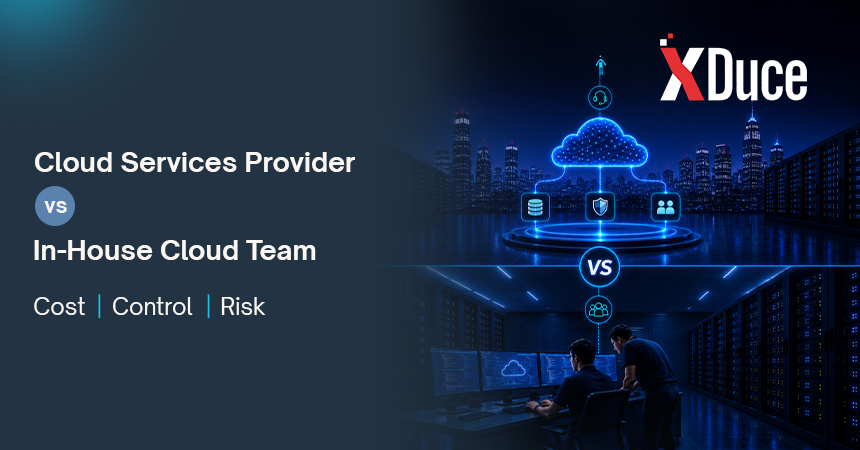
At some point, almost every growing business runs into the same fork in the road. Do you hire and build your own cloud team, or do you bring in a cloud services provider who already has the people, tools, and experience in place? It feels like a simple staffing question at first, but it is really a decision about cost, control, and how much risk your business is willing to carry.
We covered the basics of what these providers do in our complete guide to what a cloud services provider actually does. Here, we are digging into the part that matters most once you are past the basics, the actual tradeoffs between hiring your own team and working with an outside partner.
The Real Cost of Building an In-House Cloud Team
On paper, hiring in-house looks like it gives you more control for less money over time. In practice, it rarely works out that simply.
A single experienced cloud engineer in the United States commands a salary that most mid-sized businesses feel immediately. Multiply that by the number of specialists you actually need, and the picture changes fast. A full in-house setup usually means hiring separately for:
- Cloud architecture
- Security
- Ongoing operations and support
Add benefits, training, and the tools and licenses your team needs to do the job right, and an in-house team becomes a serious line item before it ever touches a single server.
Working with a cloud computing service provider flips that math. You are not paying for full-time salaries and benefits for a handful of specialists. You are paying for access to an entire team’s worth of expertise, spread across the actual hours your business needs it.
Control: What You Keep and What You Hand Off
This is usually where business owners get nervous, and it is a fair concern. Handing your cloud environment to an outside provider can feel like giving up control of something critical to your operations.
The reality is a little more nuanced.
With a cloud services provider, you keep:
- The final say on what gets built
- Decision-making power over data policies and priorities
- Full visibility into what is happening in your environment
What you hand off is:
- Day-to-day execution
- Monitoring
- The specialized technical work your team may not have time to develop
An in-house team does give you direct, hands-on control, and for some businesses, especially those with very specific or highly sensitive workloads, that matters enough to justify the cost. But direct control only helps if your team has the depth to back it up. A single in-house engineer covering cloud infrastructure, security, and support all at once is not really control. It is a single point of failure wearing three hats.
Risk: The Piece Most Businesses Underestimate
Cost and control get most of the attention in this decision, but risk is where things actually go wrong.
With a small in-house team, risk tends to concentrate in a few places:
- Your one cloud specialist leaves, gets sick, or is out during an incident, and your business is exposed at the worst possible moment
- Small teams struggle to keep up with the constant stream of security patches, compliance updates, and platform changes that AWS and Azure roll out
- One person often ends up covering far more ground than they should
This is exactly where a cloud security consultant earns their keep, watching for exposure points your internal team might not have the bandwidth to catch. Our backup and disaster recovery services exist for this same reason, since a strong recovery plan is often what separates a bad day from a business-ending one.
A managed provider spreads that risk out differently:
- Coverage does not depend on one person being available
- Security monitoring does not stop because someone is on vacation
- Redundancy is built in, instead of something you have to build and pay for yourself
That kind of redundancy is difficult and expensive to build internally unless your business is large enough to need a full cloud department anyway.
Where This Plays Out Differently by Business Size
Cloud services for enterprises often come with enough scale that an internal cloud team makes sense as part of a larger IT organization, frequently working alongside a managed partner rather than instead of one. Large enterprises tend to use a hybrid model, keeping strategic decisions in-house while leaning on outside expertise for specialized work like migrations, detailed in our cloud native application development services, or ongoing security oversight.
Cloud services for small business owners look different. Building a full internal cloud team rarely makes financial sense when the workload does not justify multiple full-time hires. This is usually where cloud solutions for small businesses lean heavily on a managed cloud computing service provider, gaining access to enterprise-level expertise without the enterprise-level payroll.
Comparing the Two Paths
| Factor | In-House Cloud Team | Cloud Services Provider |
|---|---|---|
| Upfront cost | High, driven by salaries and benefits | Lower, based on services used |
| Ongoing cost | Fixed, regardless of workload changes | Scales with actual business needs |
| Availability | Limited to your team’s hours and headcount | Around the clock coverage |
| Security expertise | Depends on who you hire and retain | Built in, with dedicated specialists |
| Risk exposure | Concentrated in a few individuals | Spread across a full team |
| Speed to scale | Slower, tied to hiring | Faster, tied to service agreements |
Making a Decision That Actually Fits
There is no universally right answer here, only the right answer for where your business is today. If you already have a mature, well-staffed internal team and the budget to support it properly, keeping cloud management in-house can work well. If you are trying to stretch a lean team across too many responsibilities, or if you are growing faster than your hiring can keep up with, working with an experienced cloud services provider usually closes that gap faster and with less risk.
If you are not sure which side of that line your business falls on, our digital transformation consulting team can take a look at where you stand today and help you figure out what actually makes sense before you commit to either path.
Frequently Asked Questions
Not usually, once you add it all up. Salaries, benefits, training, and tools for even a small internal team stack up fast, and most businesses do not need that level of staffing full time. A provider lets you pay for what you actually use instead of carrying that overhead year round.
Not really, no. You still make the calls on priorities, data policies, and what gets built. What changes is who handles the day-to-day execution. Most business owners find that trade works in their favor once they see how much time it frees up.
The biggest one is that your whole cloud operation depends on a couple of people being available at the right time. If someone leaves or is out during an incident, you can end up exposed right when it matters most. That is a hard risk to avoid with a small team.
No, and that is not really the goal. A cloud security consultant usually works alongside your existing team, filling in the specialized security knowledge that most internal IT staff simply do not have time to build on their own.
There is not a hard number, but generally once your cloud workloads are large and complex enough to keep a few full-time specialists genuinely busy, an internal team starts to make more financial sense, often working alongside outside support rather than replacing it entirely.
Related Blogs