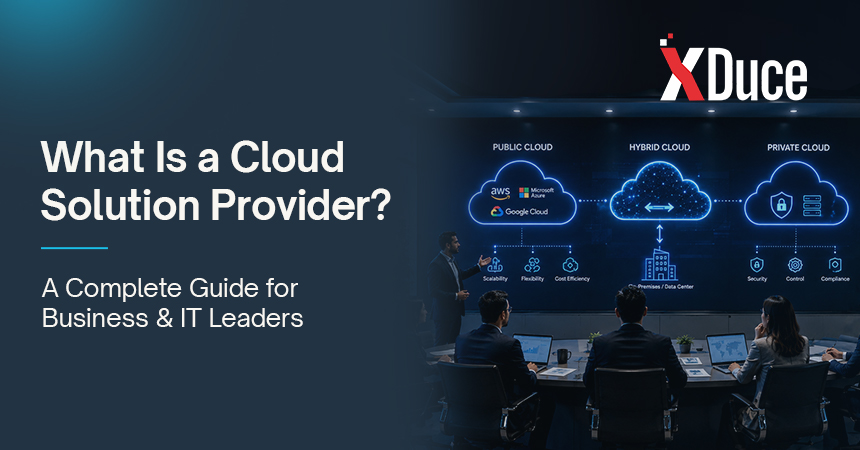
Introduction
If you have ever sat through a budget meeting where someone asked “why are we still running our own servers,” you already understand the pull toward the cloud. But moving to the cloud is not a single decision. It is a series of choices about architecture, security, cost, and who is going to manage all of it once the migration is done. That is where a cloud solution provider comes in.
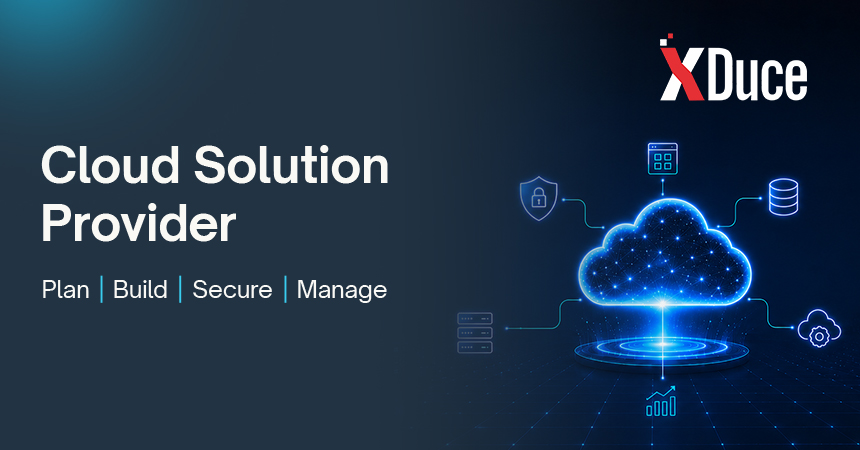
- A cloud solution provider is a company that helps businesses plan, build, secure, and manage their cloud infrastructure, whether that means public cloud platforms like AWS and Microsoft Azure, private cloud environments, or a mix of both
- Instead of hiring and training an internal team to handle every layer of cloud operations, businesses lean on a cloud services provider that already has the certifications, tooling, and hands-on experience to do it faster and, in most cases, more affordably
- The demand for this kind of partner has grown alongside the complexity of cloud platforms themselves, with AWS alone offering hundreds of individual services and Azure not far behind
- Very few internal IT teams can realistically stay current on all of them while also keeping the lights on for daily operations, which is the gap a cloud solution provider exists to close
- This guide walks through what a cloud solution provider actually does day to day, how the role differs from a general cloud computing service provider, the core services you should expect, the deployment models a provider typically works across, and how to figure out whether your business is ready to bring one on
Public Cloud, Private Cloud, and Hybrid Cloud: What a Provider Actually Works With
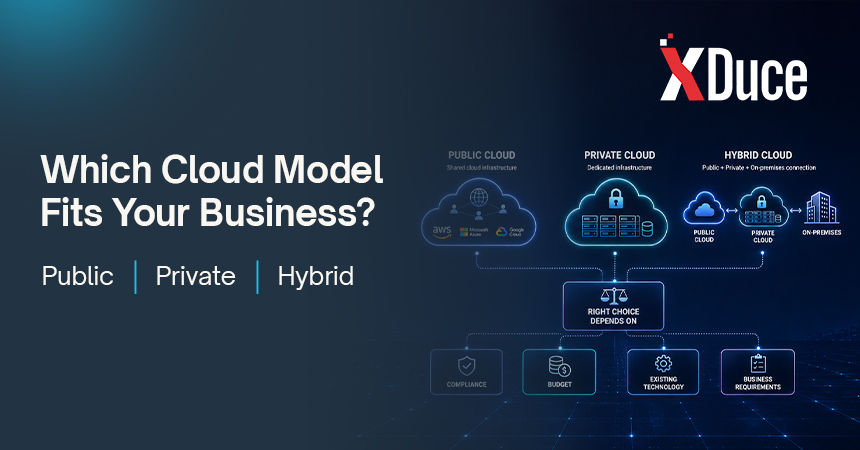
Before getting into what a cloud solution provider does, it helps to understand the environments they work in. Most businesses land in one of three categories:
| Deployment Model | What It Means | Best Fit For |
|---|---|---|
| Public cloud | Shared infrastructure from AWS, Azure, or Google Cloud | Businesses that want speed and lower upfront cost |
| Private cloud | Dedicated infrastructure, either self-hosted or provider-managed | Heavily regulated industries with strict data residency needs |
| Hybrid cloud | A mix of public and private, often with some on-premises systems | Businesses migrating gradually or with legacy systems that cannot move yet |
A capable cloud solution provider does not push every client toward the same model. Part of the job is recommending the deployment approach that fits your compliance requirements, budget, and existing technology, rather than defaulting to whichever platform the provider happens to specialize in.
What Does a Cloud Solution Provider Actually Do
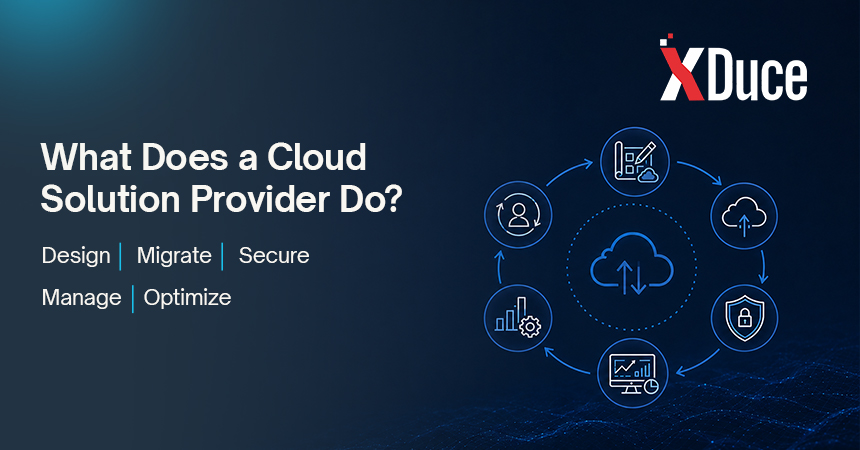
At its core, a cloud solution provider takes over the technical heavy lifting of running a modern IT environment in the cloud. A typical engagement covers:
- Designing the cloud architecture around your workloads and growth plans
- Migrating existing applications, servers, and data with minimal downtime
- Setting up monitoring, alerting, and security controls from day one
- Managing the environment on an ongoing basis so it stays patched, available, and cost efficient
- Scaling resources up or down as demand changes instead of over-provisioning by default
The scope varies by provider and by client. Some businesses only need help with a one-time migration. Others hand over full day-to-day management, essentially treating the provider as an extension of their IT department. A good cloud solution provider will scope the engagement around what you actually need rather than pushing a one-size-fits-all package.
Cloud Solution Provider vs. Cloud Computing Service Provider: Is There a Difference
You will see these terms used almost interchangeably, and in practice there is a lot of overlap. A cloud computing service provider is often used as a broader label that covers everything from raw infrastructure vendors like AWS and Azure to the consulting firms that help businesses use those platforms well.
A cloud solution provider usually sits closer to the client-facing, advisory side of that spectrum. Rather than owning the data centers, a cloud solution provider builds solutions on top of major cloud platforms and takes responsibility for making sure those solutions actually fit the business, not just the technical checklist.
Core Services Offered by a Cloud Solution Provider
Most established providers offer a consistent set of services, even if the packaging looks different from vendor to vendor.
Cloud Advisory and Strategy
Before any workload moves, a provider typically runs an assessment of your current environment, cost structure, and business goals. This is where decisions get made about which cloud advisory services best fit the business, which platform to use, and what the migration roadmap looks like.
This phase also involves mapping dependencies between applications, since moving one system without accounting for what it talks to is one of the most common causes of a botched migration.
Application Modernization
Legacy applications rarely move to the cloud as-is without problems. Application modernization services rework outdated software so it can actually take advantage of cloud scalability instead of just being hosted on someone else’s servers.
This can range from small adjustments, like updating how an application handles storage, to a full rebuild using containers and microservices. The right level of effort depends on how much longer the application needs to stay in service.
Managed Cloud Services
Once workloads are live, someone has to watch them. Managed cloud services cover monitoring, patching, performance tuning, and incident response, so internal teams are not stuck fielding 2 a.m. alerts.
Most providers also include cost monitoring here, flagging unused resources or oversized instances before they quietly inflate the monthly bill.
Backup and Disaster Recovery
A backup and disaster recovery service protects the business when something goes wrong, whether that is accidental deletion, a ransomware attack, or a regional outage at the cloud platform itself.
The best providers test recovery plans regularly rather than assuming backups will work when needed. A backup that has never been restored is really just a guess.
Cloud Security
Security cannot be an afterthought once data leaves an on-premises server room. Many providers bring in a dedicated cloud security consultant to handle identity management, encryption, compliance mapping, and ongoing vulnerability monitoring.
This typically includes setting up least-privilege access controls, so employees and systems only have permissions for what they actually need, which limits the damage if any single account is compromised.
How a Typical Cloud Solution Provider Engagement Works
Most engagements follow a similar arc, even if the terminology differs from provider to provider:
- Discovery and assessment, mapping your current infrastructure, applications, and costs
- Strategy and architecture design, choosing the deployment model and target platform
- Migration planning, sequencing which workloads move first and how downtime is minimized
- Execution, the actual move of data, applications, and configurations to the cloud
- Optimization, rightsizing resources and tuning performance after go-live
- Ongoing management, the day-to-day monitoring, patching, and support that keeps everything running
Common Mistakes Businesses Make When Moving to the Cloud
A provider earns their fee partly by helping you avoid mistakes that are expensive to fix after the fact:
- Migrating everything at once instead of moving workloads in a sequenced, tested order
- Underestimating how much legacy applications need to change before they run well in the cloud
- Treating cloud security as identical to on-premises security instead of adapting controls for a shared-responsibility model
- Skipping a cost forecast, then getting surprised by the first full month’s invoice
- Assuming backups are working without ever actually testing a restore
Industries That Rely Heavily on Cloud Solution Providers
While virtually every industry uses cloud infrastructure today, a few sectors lean on outside providers especially heavily because of compliance demands or the pace of change they face:
- Healthcare, where HIPAA compliance and patient data security require constant vigilance
- Financial services, where uptime and fraud monitoring carry direct revenue and regulatory consequences
- Retail and e-commerce, where traffic spikes during peak seasons demand elastic scaling
- Manufacturing, where legacy systems and newer IoT platforms need to work together
- Professional services firms that need secure, remote access to client data without maintaining their own data center
Cloud Services for Enterprises vs. Cloud Services for Small Business
The underlying cloud platforms are the same for every business, but the way a provider packages and prices the work should not be:
| Factor | Cloud Services for Enterprises | Cloud Services for Small Business |
|---|---|---|
| Focus | Scale, compliance, multi-region redundancy | Simplicity, speed, predictable cost |
| Onboarding | Often multi-month with custom scoping | Days to a few weeks |
| Support model | Dedicated account team, custom SLAs | Shared support tiers, standard SLAs |
| Pricing | Custom, usage and contract based | Flat or tiered packages |
Benefits of Working With a Cloud Solution Provider
The reasons businesses bring in outside help tend to repeat across industries:
- Lower upfront costs compared to building and staffing an internal cloud team
- Access to certified engineers across AWS, Azure, and other platforms without a long hiring process
- Faster migrations, since the provider has done this before and knows where projects usually stall
- Stronger security posture through dedicated monitoring and a cloud security consultant on call
- Predictable monthly spending instead of unplanned infrastructure bills
How to Know Your Business Needs a Cloud Solution Provider
A few signs tend to show up before businesses make the call:
- IT costs keep climbing even though usage has not changed much
- Internal staff spend more time firefighting servers than working on projects that move the business forward
- A security audit turns up gaps nobody had the bandwidth to fix
- Leadership wants to move faster than the current infrastructure allows
- A recent outage or data loss incident exposed how thin the backup plan really was
None of these on their own means you need a full-time internal cloud team. In most cases, a cloud solution provider can solve the same problems for a fraction of the cost and time.
What Influences Cloud Solution Provider Pricing
Costs vary widely between providers and engagements. A few factors tend to drive most of the difference:
- The number and complexity of workloads being migrated or managed
- Whether the engagement is a one-time project or ongoing managed services
- The level of support coverage, such as business hours only versus 24/7 monitoring
- Compliance requirements that add auditing and documentation overhead
- How much application modernization work is needed before migration
Choosing the Right Cloud Solution Provider
Not every provider is a fit for every business. Platform certifications, industry experience, security practices, and how they price their services all matter. We cover the full evaluation process, including the questions worth asking before you sign a contract, in our companion guide on how to choose a cloud solution provider.
Frequently Asked Questions
A cloud service provider often refers to the underlying infrastructure vendor, such as AWS or Microsoft Azure. A cloud solution provider typically builds, migrates, secures, and manages solutions on top of that infrastructure, tailored to a specific business.
Many small businesses benefit from cloud solutions for small businesses because it removes the need to hire specialized IT staff while still getting enterprise-grade security and uptime.
Pricing depends on the scope of work, ranging from a single migration project to ongoing managed cloud services. Most providers offer tiered packages so enterprises and smaller businesses can find a fit for their budget.
A cloud security consultant assesses identity and access controls, encryption practices, and compliance requirements, then works to close any gaps before they turn into incidents.
Yes. Application modernization is one of the core services most providers offer, reworking legacy software so it can run efficiently and securely in a cloud environment.
It depends on the number and complexity of workloads, but most migrations run anywhere from a few weeks for a single application to several months for a full enterprise environment.
It depends on compliance requirements, existing systems, and budget. A good cloud solution provider will recommend the deployment model that fits the business rather than defaulting to one platform.

Related Blogs