Introduction
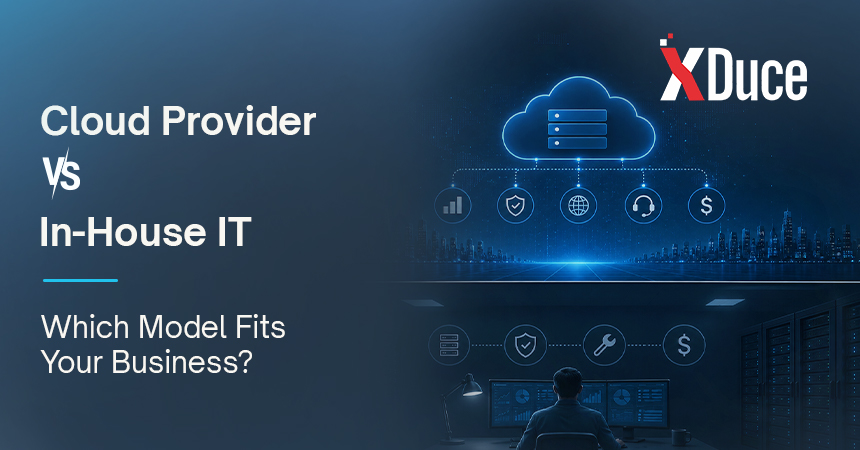
Sooner or later, most growing businesses face the same debate: keep building out an internal IT team, or bring in a cloud solution provider to handle infrastructure instead. There is no universal right answer here. The better choice depends on your budget, how specialized your workloads are, and how much control you want to retain in-house.
This decision also tends to resurface every time the business hits a growth milestone. What worked with fifteen employees rarely still works at 150, and the infrastructure decisions that felt optional early on start to feel urgent once customers, compliance auditors, or investors start asking pointed questions about uptime and security.
Here is how the two models actually compare, category by category, so you can make the call based on your specific situation rather than a generic recommendation.
What an In-House IT Team Looks Like
An in-house team means hiring, training, and retaining staff who manage your infrastructure directly, whether that is on-premises servers, cloud environments, or a hybrid setup. You get full control and staff who know your business deeply. You also carry the full cost of salaries, benefits, ongoing training, and the risk of losing institutional knowledge when someone leaves.
- Pro: deep, business-specific knowledge that builds over time
- Pro: full control over priorities, without competing for a provider’s attention
- Con: hiring specialists across every cloud discipline is slow and expensive
- Con: coverage gaps during vacations, sick leave, or turnover
- Con: staying current on every platform update falls entirely on your own team
What a Cloud Solution Provider Brings Instead
A cloud services provider gives you access to a team of specialists, often with certifications across multiple platforms, without the overhead of full-time salaries for each specialty. You are essentially renting expertise on demand, scaling support up or down as your needs change.
- Pro: access to a broader bench of specialists than most internal budgets can support
- Pro: support coverage that does not disappear when one person goes on leave
- Pro: exposure to a wider range of client environments, which sharpens troubleshooting speed
- Con: less day-to-day familiarity with the specific nuances of your business
- Con: shared attention across the provider’s other clients, depending on contract terms
Cost, Security, and Scalability Side by Side
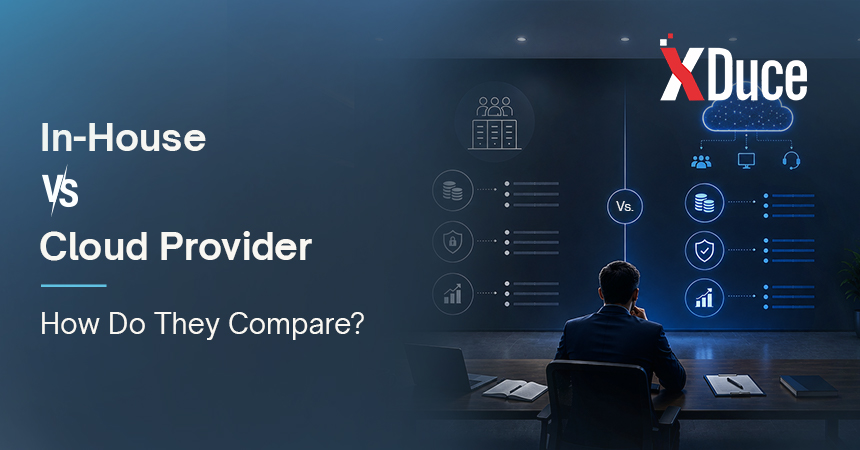
Here is how the two models stack up across the factors that matter most to leadership:
| Factor | In-House IT Team | Cloud Solution Provider |
|---|---|---|
| Cost structure | Multiple specialist salaries, benefits, training | Predictable monthly or project-based fee |
| Security depth | Depends on continuous internal training | Dedicated cloud security consultant across many clients |
| Scaling speed | Weeks to months, tied to hiring | Days, reallocated on demand |
| Institutional knowledge | Deep but at risk if staff leave | Distributed across the provider’s team |
Building an internal team capable of covering cloud architecture, security, and day-to-day operations usually means multiple hires, each commanding a specialist salary. A cloud solution provider bundles that expertise into a predictable fee that is often lower than the fully loaded cost of equivalent in-house staff, particularly for businesses that do not need full-time coverage in every specialty.
Which Is Better for Small Businesses vs. Enterprises
For small businesses, the math usually favors a provider. Cloud services for small business rarely justify the cost of a full internal specialist team, and cloud solutions for small businesses are built to be managed externally without heavy internal oversight.
Enterprises face a more nuanced decision. Cloud services for enterprises often combine both models, keeping a lean internal team for strategy and governance while outsourcing the operational workload to a provider. Very large organizations with highly specialized, proprietary systems sometimes justify a fully in-house team, but this is the exception rather than the rule.
Signs Your Current Model Is Not Working
Regardless of which model you currently use, a few patterns suggest it might be time to reconsider:
- Your internal team spends most of its time on routine maintenance instead of strategic projects
- You have had more than one preventable outage in the past year
- Hiring for a specialized cloud role has taken months with no strong candidates
- Your provider’s response times have gotten noticeably slower as your account has grown
- Compliance requirements have outgrown what your current setup can support
A Simplified Cost Breakdown Example
Numbers vary widely by business, but a simplified example helps illustrate where the cost difference tends to come from. A mid-sized business running a small in-house team might carry the combined cost of a cloud engineer, a security specialist, and a portion of a manager’s time, plus benefits and training, before any hardware or licensing is factored in. A comparable cloud solution provider engagement often bundles equivalent coverage into a single predictable monthly fee, since that expertise is shared across the provider’s full client base rather than dedicated to one company alone.
This does not mean a provider is automatically cheaper in every case. Businesses with very large, steady workloads sometimes find that a well-staffed internal team reaches cost parity over time. The comparison is worth running with your own numbers rather than assuming either model wins by default.
A Few Real-World Scenarios
It helps to see how this plays out at different company sizes:
| Business Profile | Common Approach | Why |
|---|---|---|
| 10-person startup | Full cloud solution provider, no internal IT hire | Cannot justify a specialist salary yet |
| 80-person mid-market firm | One internal IT generalist plus a provider for specialized work | Needs daily support but not full specialist coverage |
| 800-person enterprise | Lean internal governance team plus a provider for operations | Needs scale and compliance depth beyond internal capacity |
| Regulated healthcare group | Hybrid model with strict provider compliance requirements | Needs both internal oversight and outside expertise |
Making the Transition Smooth If You Switch Models
Businesses that move from an in-house team to a cloud solution provider, or the other way around, tend to have an easier time when they treat it as a phased handoff rather than a single cutover date.
- Document current infrastructure, credentials, and processes before anything changes hands
- Run a short overlap period where both the old and new setup can be cross-checked
- Move lower-risk systems first to validate the new arrangement before touching anything business-critical
- Set a clear communication plan so staff and customers know what to expect during the transition
- Schedule a formal review 60 to 90 days after the switch to catch anything that slipped through
The Hybrid Model: Using Both Together
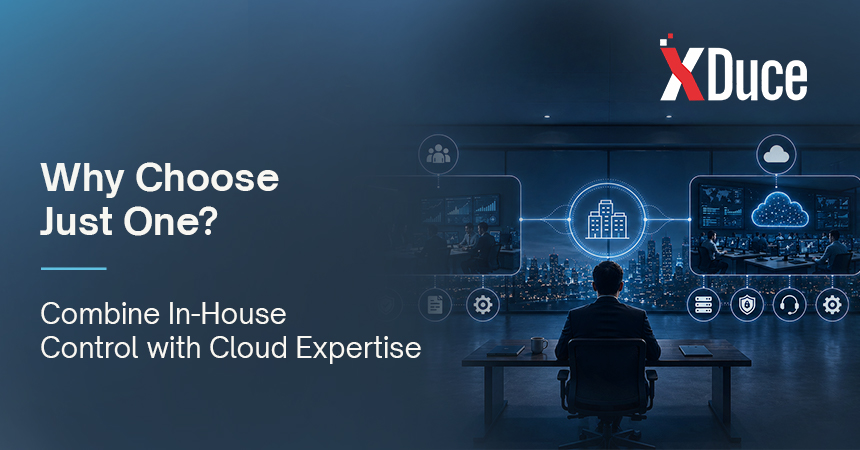
Many businesses land somewhere in between, keeping a small internal team focused on strategy, vendor management, and business-specific systems, while a cloud solution provider handles infrastructure, security monitoring, and managed cloud services day to day. This model captures the control benefits of in-house staff without the full cost and hiring burden.
The hybrid approach also gives businesses a natural on-ramp. Many companies start by outsourcing a single function, like backup and disaster recovery or security monitoring, then expand the relationship once they see how the provider performs under real conditions.
Questions to Ask Before Deciding
A short set of honest questions can clarify which direction makes sense:
- Can we realistically afford to hire and retain specialists across every cloud discipline we need
- How much of our current IT time goes to routine maintenance versus strategic projects
- What happens to coverage if a key internal IT staff member leaves tomorrow
- Do we have compliance requirements that demand a certain level of internal oversight
- Would a hybrid model let us keep the control we need while still closing our expertise gaps
The People Side of the Decision
Cost and capability tend to dominate this conversation, but the impact on existing staff deserves equal attention. Bringing in a cloud solution provider does not have to mean replacing internal IT jobs. In most successful transitions, internal staff shift from routine maintenance work toward higher-value projects, like internal tooling, vendor management, or process improvement, while the provider absorbs the repetitive operational load.
Handled poorly, though, the shift can feel like a threat rather than a relief. Businesses that communicate early about what is changing, and what is not, tend to see far less resistance and turnover during the transition than those that spring the decision on their team without warning.
What Each Model Means for Compliance and Audits
For regulated industries, this comparison has an extra dimension. An in-house team gives auditors a single, fully internal chain of custody for data and systems, which some compliance frameworks prefer by default. A cloud solution provider can still meet the same requirements, but it usually means formalizing the relationship through a business associate agreement, data processing agreement, or similar contract that spells out exactly where responsibility sits between your business and the provider.
Neither approach is automatically more audit-friendly. What matters is documentation. Auditors generally care less about who performs the work and more about whether responsibilities, access controls, and incident response processes are clearly defined and consistently followed.
How to Decide With Confidence
There is rarely a purely technical answer to this decision. It usually comes down to weighing control against cost, and certainty against flexibility. A useful way to frame it: an in-house team is an investment in permanent capability, while a cloud solution provider is an investment in flexible capacity. Neither is wrong. The right choice depends on which one your business actually needs more of right now.
It is also worth revisiting the decision periodically rather than treating it as permanent. A model that made sense at 20 employees may not make sense at 200, and a business that outsourced everything during a lean early stage may eventually want to bring some functions in-house as it matures and the internal expertise becomes worth the investment.
Frequently Asked Questions
In most cases, yes, particularly for small and mid-sized businesses that do not need full-time specialists in every area of cloud operations.
Yes. Many businesses transition gradually, starting with managed cloud services for specific workloads before expanding the relationship.
Not necessarily. Providers with a dedicated cloud security consultant often see a wider range of threats across clients, which can translate into faster detection and response times.
Most do, typically a lean team focused on strategy and governance, while the provider handles day-to-day infrastructure and operations.
Limited scalability and single points of failure, since capacity is tied to a fixed number of staff who can leave, get sick, or simply be stretched too thin during growth periods.
If you have compliance requirements that demand internal oversight but also need broader technical coverage than your current staff can provide, a hybrid model that keeps strategy in-house while outsourcing operations is usually a good fit.
Backup and disaster recovery and security monitoring are common starting points, since they are easy to scope and let a business evaluate a provider before expanding the relationship.

Related Blogs