Introduction
Should you handle this with your own IT team, or bring in an IT services provider to help? Almost every enterprise runs into this question sooner or later. Your internal team knows your business inside and out. An outside partner brings specialized skills, extra capacity, and round-the-clock coverage that your team may not have the time or resources to build on its own.
There’s no single right answer. It really comes down to a few simple questions:
- What are you actually trying to do?
- How fast do you need to move?
- Can your internal team realistically take this on right now, on top of everything else it already supports?
This article walks through where each option works best, where it tends to fall short, and how most enterprises end up combining the two. If you want the basics first, check out our guide on what an IT services provider does. This article picks up from there.
The question comes up in different forms depending on the initiative. It might mean evaluating a full-scale digital transformation company for a multi-year modernization effort, a software development company for a single custom application, or ongoing IT consulting services to support daily operations. Whatever the label, the underlying decision, build it internally or bring in outside enterprise technology solutions, is largely the same.
Why This Comparison Matters Right Now
IT needs keep expanding in scope. What used to mean keeping the network running and fielding helpdesk tickets now often means cybersecurity monitoring, cloud migration, application development, compliance, and AI adoption, sometimes all at once. Internal IT teams are being asked to support more with the same headcount, and that gap is exactly where the build-versus-partner question becomes urgent.
A few things are driving this:
- Skill gaps are widening. Cybersecurity, cloud infrastructure, and AI adoption move fast enough that even strong internal teams struggle to stay current on every front.
- Budgets are under more scrutiny. Leadership wants to see a clear return on any technology investment, whether that spend goes to new hires or an outside partner.
- Speed and availability matter more than they used to. Competitors that modernize and respond faster gain a real advantage, and hiring a full internal team from scratch, or staffing round-the-clock coverage, takes time and money most enterprises don’t have to spare.
- Risk tolerance varies by project. A patch to an internal tool is a very different risk profile than a security incident or a core system migration touching customer data.
For US enterprises in particular, this pressure is compounded by a tight labor market for specialized IT talent. Recruiting and retaining skilled staff for cybersecurity, cloud, and software development roles takes time that many American businesses simply don’t have when a project is already on the clock.
None of this means one option beats the other across the board. It means the decision deserves more thought than “let’s just have IT handle it” or “let’s just hire a vendor.”
What Your In-House IT Team Does Best
Internal teams have advantages that are easy to undervalue, mostly because they’re less visible than a vendor’s marketing page.
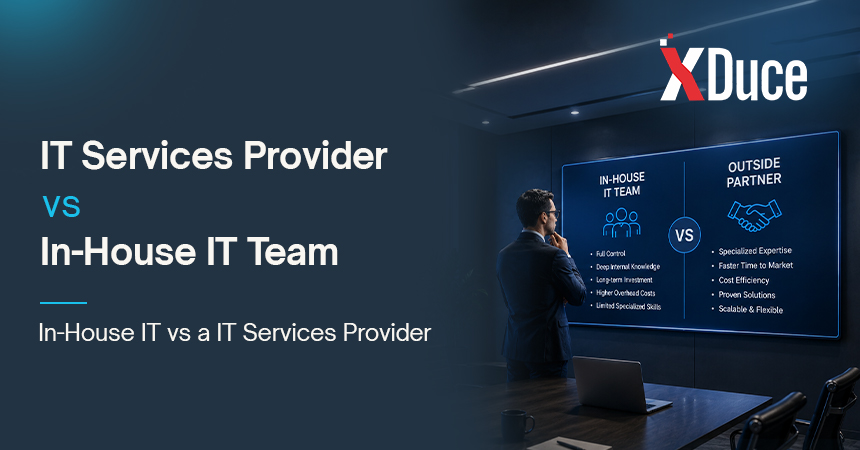
- Deep institutional knowledge. Your team knows why systems were built the way they were, which shortcuts were taken years ago, and where the bodies are buried in your legacy code. That context takes years to build and can’t be handed over in a discovery workshop.
- Direct accountability. Internal staff report to the same leadership you do, and they’re not going anywhere once a project wraps. That ongoing ownership matters for systems that need ongoing care.
- Faster day-to-day decisions. No contract negotiations, no change orders, no waiting on a vendor’s account manager to loop in the right specialist. Small changes can happen quickly.
- Lower cost for steady-state work. For maintenance, minor enhancements, and routine support, an internal team is often more cost-effective than bringing in outside help for every small request.
Where internal teams tend to struggle is scale, breadth, and always-on coverage. A team built to keep existing systems running smoothly during business hours isn’t always equipped to lead a multi-year cloud initiative, staff a 24/7 security operations function, or take on a full application modernization effort on top of their regular workload.
What an IT Services Provider Brings to the Table
A strong external partner earns its cost by covering gaps that are expensive and slow to build internally.
- Breadth of specialized expertise. An IT services provider works across many clients and industries, which means the team has likely already solved the specific problem you’re facing, whether that’s a tricky cloud migration, a cybersecurity gap, or a compliance-heavy modernization project. Depending on the engagement, that partner might function as a digital transformation company leading a broader modernization roadmap, a software development company building a specific application, or a full IT consulting services firm supporting several needs at once.
- Faster time to value. Providers bring proven playbooks, existing tooling, and established processes instead of building an approach from scratch. That usually means faster delivery, assuming the provider is a good fit for your project.
- Flexible capacity. You can scale a provider relationship up for a big initiative or a staffing gap, and scale it back down once the heavy lifting is done, without the long-term cost of a permanent headcount increase.
- Round-the-clock coverage. Managed monitoring, helpdesk, and security operations are hard to staff internally around the clock. A provider can offer that coverage as a standing service rather than a one-off project.
- Outside perspective. Internal teams sometimes get too close to legacy decisions to see them clearly. An outside partner can push back on assumptions that have gone unquestioned for years.
- 24×7 support and escalation. When something breaks at 2 a.m., a provider with a staffed support desk and defined SLAs can triage and start fixing it immediately, instead of waiting for someone to notice the next business morning.
The tradeoff is cost per hour, a learning curve on your specific environment, and the risk of choosing a provider who overpromises. That’s exactly why the vendor evaluation process matters so much when you’re weighing your options.
Side-by-Side: How the Two Approaches Compare

| Factor | In-House IT Team | IT Services Provider |
|---|---|---|
| Institutional knowledge | Strong, built over years | Limited at first, requires ramp-up |
| Specialized technical depth | Varies by team size and budget | Broad, across cloud, cybersecurity, applications, and IT operations |
| Speed on large initiatives | Often slower due to competing priorities | Usually faster, with dedicated capacity |
| Cost for ongoing maintenance | Generally lower | Generally higher per hour |
| Cost for large one-time initiatives | Can require new hires or training | Often more cost-effective than building from scratch |
| Coverage and availability | Limited to internal staff hours and headcount | Can offer 24/7 monitoring and support |
| Accountability | Direct, long-term | Contractual, project- or SLA-based |
| Flexibility to scale | Limited by headcount | High, can flex up or down |
| Risk of misalignment | Low, deep business context | Higher if vendor fit is poor |
No single row in this table settles the decision on its own. The right mix depends on the specific initiative in front of you.
When In-House IT Makes the Most Sense
- The work is routine maintenance, small enhancements, or day-to-day support for systems your team already understands well.
- Your team already has the specific skills the project needs, and taking on the work builds valuable long-term capability.
- The initiative touches sensitive processes where deep institutional knowledge matters more than speed.
- Budget constraints make an external engagement difficult to justify for a smaller-scope project.
When an IT Services Provider Makes the Most Sense
- The project requires specialized skills your team doesn’t have and won’t need often enough to justify hiring for permanently, such as a large-scale cloud migration, a cybersecurity overhaul, or enterprise-wide AI adoption.
- Timeline pressure means you can’t afford the months it would take to hire and train internally.
- The initiative is large enough that your internal team can’t take it on without neglecting their existing responsibilities.
- You need continuous, round-the-clock coverage, such as monitoring, helpdesk, or security operations, that isn’t practical to staff internally.
- You need an outside perspective to challenge assumptions baked into decade-old systems.
The Hybrid Approach Most Enterprises Actually Use
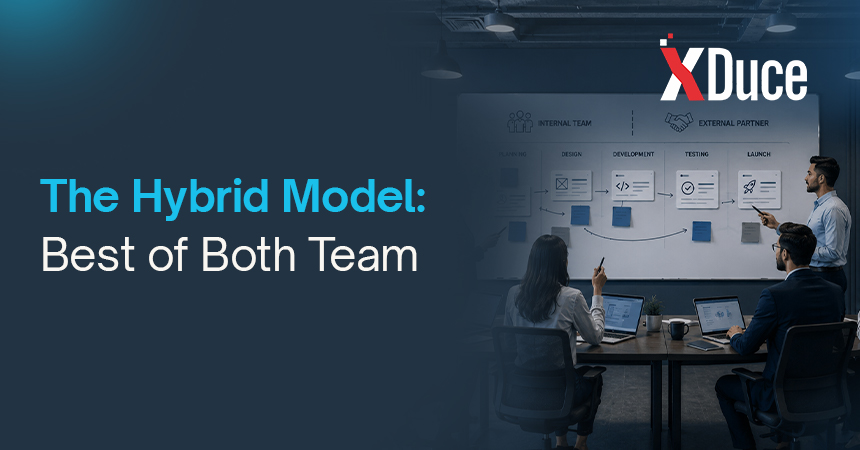
In practice, very few enterprises pick one option and stick with it exclusively. The more common pattern looks like this: internal IT owns the systems day to day and understands the business context, while an IT services provider gets brought in for the initiatives, coverage, or specialized skills that would be expensive or slow to build in-house.
This hybrid model tends to work well because it plays to each side’s strengths. Internal teams keep ownership and institutional knowledge. The external partner handles the technical heavy lifting or ongoing managed services on a defined scope, then transfers enough knowledge that your team stays informed and in control. Done well, this approach also builds internal capability over time instead of creating permanent dependency on outside help.
The key to making this work is choosing a provider who treats your internal team as a collaborator, not an afterthought. A provider who documents decisions clearly, involves your team throughout the engagement, and plans for handoff or ongoing reporting from day one leaves you in a much stronger position than one who treats the relationship as a black box.
Questions to Ask Before Deciding
- What specific skills, capacity, or coverage gap are we actually trying to fill?
- Could we close that gap with training or a new hire in a reasonable timeframe, or does the need outstrip what we can build internally?
- How much of this work is one-time versus ongoing?
- What’s our internal team’s current workload, and would this project mean neglecting something else?
- If we bring in a provider, how will knowledge and reporting flow back to our internal team?
- What’s the real cost difference once we account for hiring, training, and opportunity cost, not just hourly rates?
Why Enterprises Choose XDuce
XDuce works with enterprise IT teams as a partner, not a replacement, filling the gaps your internal team doesn’t have time to build alone.
- Global delivery footprint. Offices across the US, Canada, UK, and India, with 10+ global locations supporting round-the-clock delivery.
- Certified quality and governance. CMMi Level 5 and ISO-certified processes, with a dedicated PMO enforcing consistent governance and delivery standards across every engagement.
- Recognized technology partnerships. Platinum-level standing with Oracle, plus deep expertise across Microsoft, AWS, and Salesforce ecosystems.
- Scale with a track record. 1,500+ engineers and 4,000+ projects delivered over 25+ years, including regulated industries like insurance, banking, and the public sector.
- Ownership stays with your team. Engagements are structured so your internal team retains control of what’s built, with many relationships continuing well past the original scope.
Conclusion
The choice between an IT services provider and your in-house IT team isn’t really an either-or decision for most enterprises. It’s a question of matching the right resource to the right initiative, and being honest about where your internal team’s time and skills are best spent. For steady-state work and anything requiring deep institutional knowledge, internal IT is usually the better fit. For large, specialized, always-on, or time-sensitive initiatives, a strong IT services provider can move faster and bring expertise that would take years to build internally.
Whatever mix you land on, the decision deserves more thought than defaulting to whichever option is more familiar. Take stock of what your team does well, where the gaps are, and what a given project actually requires before deciding who leads it.
FAQs
It depends on the project. For ongoing maintenance and small enhancements, internal IT is usually more cost-effective since there’s no vendor markup on routine work. For large, specialized, one-time initiatives or coverage you’d otherwise have to staff around the clock, hiring and training internally can end up costing more than bringing in an IT services provider once you factor in recruiting time, ramp-up, and the opportunity cost of pulling your team off other priorities.
Yes, and this is actually the most common setup for enterprises. A well-run engagement has the external partner handling specialized, large-scale, or always-on work while your internal team retains ownership of day-to-day systems and long-term maintenance. The strongest partnerships involve internal staff throughout the engagement, not just at handoff, so knowledge transfers naturally instead of getting lost.
Look honestly at current workload, specialized skill gaps, and timeline pressure. If the project would require your team to learn something new from scratch while also maintaining existing systems, that’s usually a sign outside help would speed things up considerably. It also helps to ask whether the skill being built has long-term value internally, or whether it’s a one-time need better handled by a provider.
In a well-managed engagement, your internal team gains ownership of what was built, along with documentation and training needed to maintain it going forward. A good provider plans for this handoff from the start rather than treating it as an afterthought, and involves your team in decisions throughout the project so the transition doesn’t feel abrupt once the engagement ends.
Not typically. Most enterprises use outside providers to add capacity, specialized skills, or coverage for specific initiatives, not to replace existing staff. Internal IT usually continues handling day-to-day operations, security, and ongoing support while the outside provider focuses on the defined scope, then steps back or settles into an ongoing support role once the work is delivered and knowledge has transferred.
XDuce operates as all three under one roof. Depending on what an enterprise needs, that can mean leading a digital transformation company’s style modernization roadmap, acting as a software development company for a specific custom application, or providing broader IT consulting services and enterprise technology solutions for US enterprises that would rather work with a single accountable partner than juggle multiple specialist vendors.

Related Blogs