Introduction
If you’re looking for a digital transformation company, you’ll run into the same problem almost right away: too many options, and most of them sound the same on paper. Cloud expertise, agile delivery, a “proven track record,” the language barely changes from one vendor site to the next. The real differences only show up once you know what to look for and what to ask.
This decision matters more than most people realize going in:
- Pick well, and you get a partner who speeds up modernization, strengthens security, and quietly makes your operations run better month over month.
- Pick poorly, and you’re looking at blown budgets, stalled rollouts, and an internal team stuck cleaning up someone else’s mess for years.
If you haven’t already, it’s worth reading our guide on what a digital transformation company is first, it covers the basics. This article is more hands-on: how enterprise leaders actually vet these partners and land on the right one.
Why Choosing the Right Digital Transformation Company Matters
A typical digital transformation initiative runs anywhere from twelve months to three years, and it touches nearly everything: legacy system modernization, cloud migration, business process automation, and often customer-facing experience work too. That’s a long time for a third party to be embedded in how your business runs day to day, which is why this decision carries more weight than most vendor choices.
Here’s what’s actually at stake:
- Operational fit. Transformation work reshapes how your organization operates, not just what tools it uses. If your partner doesn’t understand your business model or industry constraints, you’ll be living with that mismatch long after the invoices stop coming in.
- Financial risk. Enterprise technology budgets aren’t small, and a poor vendor match is one of the more common reasons projects go over budget or miss their goals. Industry research from firms like Gartner keeps landing on the same conclusion: most failed transformations trace back to partner problems, not the technology itself.
- Scalability. Your business three years from now won’t look like it does today. Whatever architecture gets built needs room to grow, without a teardown and rebuild the moment you expand into a new market.
- Innovation vs. maintenance. Plenty of vendors are competent at keeping the lights on. Fewer are good at pushing you toward AI implementation or enterprise automation in ways that actually move the needle, rather than just checking a box on a roadmap slide.
- Measurable outcomes. The stronger partners will tell you, in plain terms, how an initiative is supposed to improve efficiency, cut cost, or strengthen the customer experience. If a vendor can’t answer that directly during the sales process, flag it early.
- Knowledge transfer. Long after the outside team moves on, your internal staff are the ones living with whatever got built. A partner who documents decisions clearly, trains your team along the way, and hands off systems your people can maintain leaves you better off than one who treats knowledge transfer as an afterthought. That holds true whether you’re a mid-market manufacturer modernizing an ERP system or a large financial services firm rebuilding core banking infrastructure.
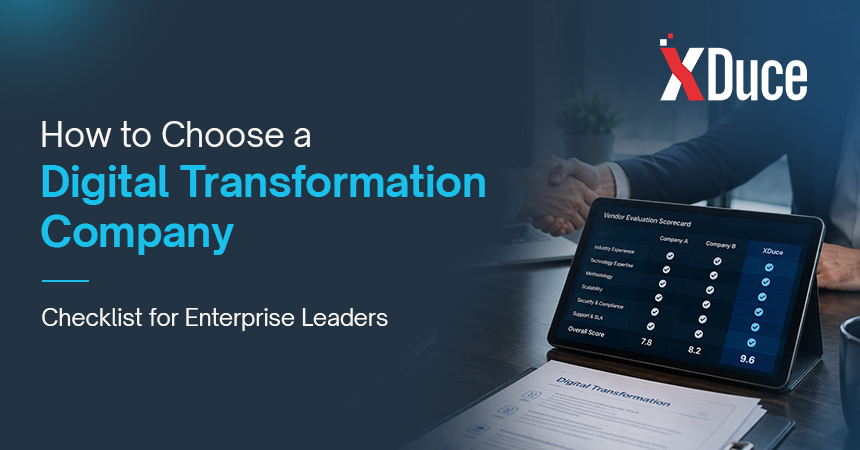
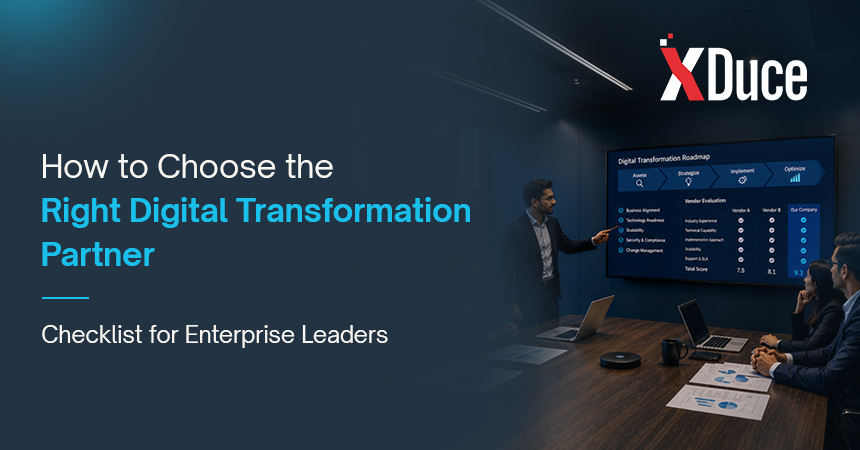
Vendor Evaluation Checklist for Enterprise Leaders
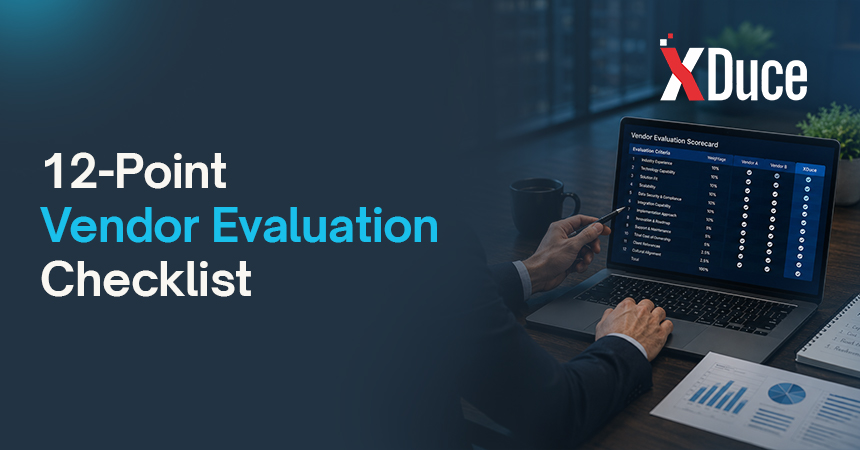
Treat the list below as a working document rather than something to read once and forget. Each item reflects a place where digital transformation company engagements commonly go sideways.
Define Your Business Objectives First
Before you contact a single digital transformation company, get your own house in order. What does success actually look like? Reduced operational costs, a modernized legacy platform, a better customer experience, some combination of the three? Vendors respond very differently to “we want digital transformation” than they do to “we need to cut manual claims processing time by 40 percent.” The second version attracts partners who can actually engage with your problem. The first tends to attract generic pitches.
Look for Relevant Industry Experience
A software development company that’s spent a decade building fintech platforms isn’t automatically the right fit for a healthcare system under strict compliance rules. Ask candidates for examples of work in your industry, or at minimum one with comparable regulatory complexity. This shortens the learning curve and cuts down on expensive missteps. A partner who already understands your regulatory environment and typical integration points doesn’t need a month to get up to speed on things you could have told them upfront.
Evaluate Technical Expertise
Skip past the marketing copy and get specific. Which cloud platforms does the team actually work in every day? Do they have real depth in Microsoft technologies and Azure consulting, or is that a line item on a capabilities page? A team that can talk through their approach in plain language, rather than falling back on buzzwords, is usually the one you want.
Review Case Studies and Client Success Stories
A case study tells you how a vendor actually works, assuming it’s written with any specificity. Where did the client start, what approach did the partner take, and what changed? If a case study reads like it could apply to any client in any industry, that vagueness is itself a signal worth noticing.
Don’t stop at the write-up, though. Ask to talk to a current or recent client whose project looked something like yours. A fifteen-minute reference call tends to surface things a polished case study never will, including how the vendor handled things when the project didn’t go according to plan. It’s worth browsing a vendor’s published case studies before that call so you know what questions to ask.
Assess IT Consulting Services
A lot of vendors on a digital transformation company shortlist are strong technologists and weak consultants. You want a partner willing to push back on your assumptions and say something when a request doesn’t line up with your goals. Good IT consulting services feel more like a partnership than an order-taking exercise.
Verify Cloud and Modernization Capabilities
Cloud migration and legacy modernization projects come with their own risks: downtime, data loss, integration failures that don’t show up until go-live. Ask how the vendor plans migrations, what their rollback procedures look like, and how thorough their testing is. A team with genuine cloud consulting and modernization experience will answer specifically. Vague or improvised answers here are a bad sign for the rest of the project.
Evaluate Software Development Capabilities
If the engagement involves custom software development or modernizing existing enterprise applications, look closely at how the team builds. Ask about DevOps maturity, code review practices, testing discipline, and how they handle technical debt. Teams with strong engineering habits early on tend to keep them through the harder stretches of a project.
Understand Security and Compliance Practices
Cybersecurity has to be part of the conversation from the start, not something bolted on before launch. Ask how the vendor builds security into the architecture itself, how they handle data during migrations, and whether they’ve worked within your industry’s compliance frameworks, whether that’s HIPAA, SOC 2, or FedRAMP.
Review Communication and Project Management Processes
How often will you get updates? Who’s your actual point of contact day to day, and what happens if they leave the account? Enterprise projects shift over time almost by definition, and you want a project management process that absorbs those changes without turning every scope adjustment into a crisis.
Assess Scalability and Long-Term Support
What happens after go-live? Plenty of vendors are strong on delivery and thin on everything after. Ask about their approach to managed IT services once the build is done, how bug fixes get handled, and whether there’s a defined support structure or just a vague promise to “be around if you need us.”
Evaluate Pricing Transparency
Enterprise engagements should come with clear, itemized pricing from the start. Watch for vendors who get cagey about cost breakdowns or resist putting assumptions in writing before you sign anything. How a vendor handles pricing conversations during the sales process is usually a good preview of how they’ll handle billing later.
Check Cultural Fit and Collaboration Style
Technical skill only gets you so far if the working relationship is a constant friction point. Some organizations want heavy documentation and formal sign-offs at every stage. Others move faster with a lighter, iterative approach. Neither is wrong, but mismatches here cause real problems, so bring in the internal team members who’ll actually work with this vendor before you make a final call.
Red Flags to Watch For
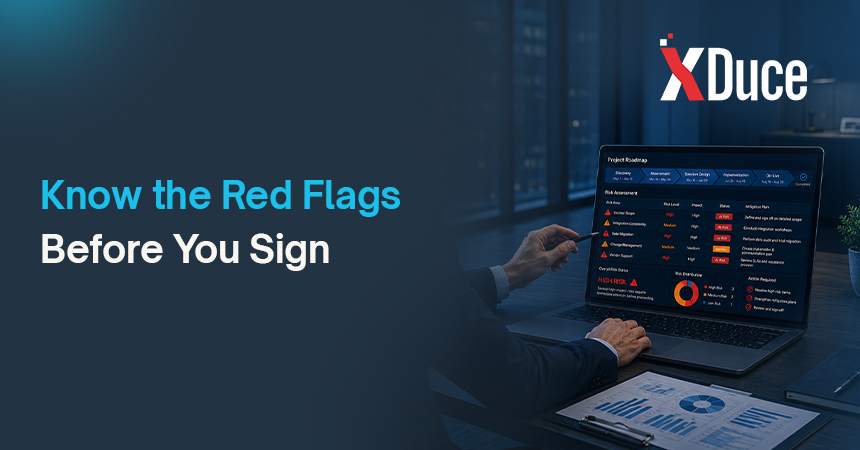
Even the most polished proposal from a digital transformation company can hide problems that only surface once the work has started. Watch for:
- Unrealistic timelines. If a vendor promises to deliver a complex modernization project in half the time everyone else quoted, ask what’s getting cut to hit that number. Something usually is.
- Vague experience claims. Generic statements about what a vendor “can” do, with no specific, verifiable examples to back it up.
- Slow or vague communication before you’ve signed anything. That pattern rarely improves once you’re a paying client.
- Hidden costs. Pricing that quietly expands once the contract is in place, or fuzzy language about what’s actually included.
- One-size-fits-all proposals. The same architecture pitched regardless of your industry is usually a sign the discovery work never happened.
- No clear way to measure success. If a vendor can’t tell you upfront how success will be measured, holding them accountable later becomes nearly impossible.
- Weak post-launch support. Ask specifically what happens 30, 60, and 90 days after go-live rather than accepting a vague assurance.
- Deflection under pointed questions. A team that answers with generalities instead of a straight answer is telling you something about how the engagement itself will go.
Questions Every Enterprise Leader Should Ask Before Signing a Contract
- Can you walk us through a project similar in scope to ours, including something that went wrong and how you handled it?
- What does your discovery process look like before you propose a technical approach?
- How do you handle scope changes once a project is underway?
- What’s your approach to data security and compliance during migrations?
- Who will be our day-to-day point of contact, and what’s their experience level?
- How do you measure and report on progress?
- What does post-launch support look like, and is it included or billed separately?
- Can you provide references from clients in our industry?
- How do you handle knowledge transfer so we’re not permanently dependent on your team?
- What happens if the timeline or budget needs to shift midstream?
More often than not, how a vendor answers these questions tells you more than anything in their proposal deck.
Why Enterprises Choose XDuce
XDuce treats every engagement as a business problem first and a technology problem second, spending real time understanding a client’s operational goals, existing systems, and constraints before recommending anything.
That mindset shapes how XDuce delivers enterprise technology solutions, from custom software development to cloud transformation to IT consulting work built around outcomes clients can actually measure. Depth across Microsoft technologies and Azure environments comes from hands-on work on legacy modernization and enterprise integration projects, the kind that don’t go well without practical experience behind them.
A number of XDuce’s client relationships have continued well past the original project, a pattern worth weighing alongside the track record across regulated industries documented in XDuce’s case studies.
Conclusion
Choosing a digital transformation company isn’t a decision to rush through. Whoever you select will shape your organization’s technology direction, operational efficiency, and ability to compete for years after the contract is signed. A structured evaluation process, one built on clear objectives, verified experience, technical scrutiny, and honest pricing conversations, gives enterprise leaders the best shot at avoiding expensive mistakes later.
Work through the checklist above with your team, and ask the harder questions before you sign anything. A partner worth choosing will welcome that scrutiny rather than avoid it.
FAQs
Most enterprises spend four to eight weeks evaluating vendors, covering initial research, proposal review, reference checks, and internal alignment across stakeholders. Larger or more regulated organizations sometimes take longer, especially when legal and procurement teams need to weigh in on contract terms. Rushing this timeline tends to raise the odds of picking a partner who isn’t actually equipped to handle your specific technical or industry requirements, so it pays to build in enough runway.
IT consulting firms typically focus on discrete technical projects or advisory engagements, often scoped narrowly around a single system or department. A digital transformation company usually takes on broader, business-wide initiatives that combine strategy, software development, cloud transformation, and organizational change over a longer stretch of time, often working across multiple business units at once rather than a single team.
It really depends on the complexity of your project and what internal resources you already have. Larger vendors tend to offer more breadth and global delivery capacity, while boutique firms often give you closer access to senior talent and a more tailored, business-first approach. Neither option is inherently better. Weigh both against your specific goals, timeline, and budget rather than defaulting to size alone as a shortcut.
Costs vary widely depending on scope, from a few hundred thousand dollars for a focused initiative to several million dollars for enterprise-wide modernization spanning multiple systems. Industry, compliance requirements, and the amount of legacy system modernization involved all affect the final number. Transparent, itemized pricing during the proposal stage makes it much easier to compare vendors accurately and avoid unpleasant surprises once the contract is signed.
Bring in representatives from IT, operations, finance, and whatever business unit is most affected by the initiative, along with procurement and legal if the contract will involve significant spend. Involving people broadly and early reduces the odds of internal disagreement after a digital transformation company has already been chosen and the project is already underway.

Related Blogs