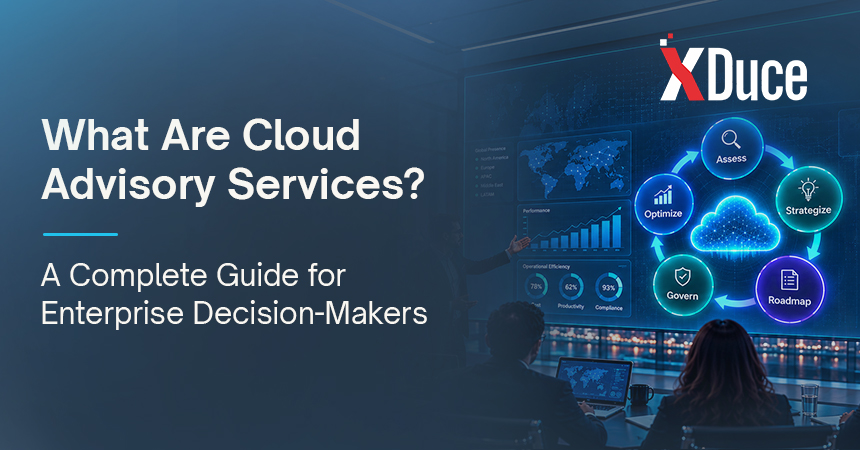
Introduction
Most enterprises don’t struggle to get into the cloud. They struggle to make the cloud actually work for the business once they’re there. Costs creep up, architecture decisions made three years ago don’t fit today’s workloads, and nobody on staff has the bandwidth to step back and ask whether the current setup still makes sense. That’s the gap cloud advisory services exist to close.
The term gets used loosely across the industry, sometimes interchangeably with cloud consulting, sometimes as a narrower slice of it. That ambiguity makes it harder for decision-makers to know exactly what they’re buying, or whether the engagement they’re considering will actually solve the problem in front of them.
This guide breaks down what cloud advisory services actually cover, how the work typically unfolds, what a strong engagement looks like from the outside, how it fits into a larger technology roadmap, and how to know when it’s time to bring one in.
What Makes a Strong Cloud Advisory Engagement
Not every engagement labeled “cloud advisory” delivers the same value. A few traits tend to separate the strong ones from the ones that produce a slide deck nobody looks at again:
- Recommendations grounded in your actual usage data, not generic industry benchmarks
- A platform-neutral starting point, rather than a predetermined push toward whichever vendor the firm partners with
- A roadmap with concrete milestones, not just a high-level direction
- Willingness to say a major migration isn’t worth it yet, when that’s the honest answer
- A clear handoff plan for whoever executes the work, whether that’s your internal team or the same firm
What Cloud Advisory Services Actually Cover
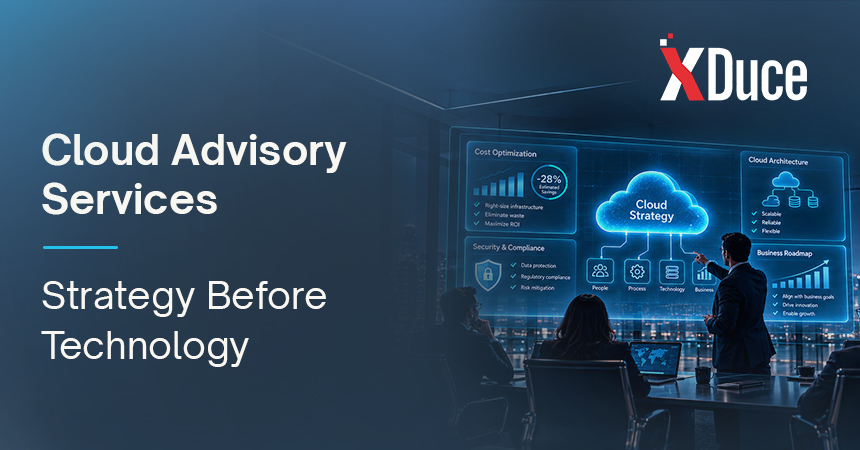
Cloud advisory services sit at the strategic layer of cloud work, above the day-to-day engineering. A comprehensive engagement typically spans:
| Service Area | What It Covers |
|---|---|
| Cloud Strategy & Assessment | Evaluating current infrastructure, applications, and spending against business goals to identify gaps and opportunities |
| Platform & Architecture Advisory | Recommending the right platform (AWS, Azure, Google Cloud) and deployment model, including hybrid and multi-cloud architecture design |
| Cost Optimization & FinOps | Building a cost governance strategy, right-sizing resources, and eliminating waste before it accumulates |
| Security & Compliance Advisory | Assessing security posture and compliance readiness against frameworks like HIPAA, SOC 2, PCI-DSS, and GDPR |
| Migration & Modernization Roadmapping | Developing a phased plan for moving workloads, modernizing legacy applications, or expanding the cloud footprint |
| Governance & Policy Design | Setting up access controls, cost policies, and decision-making frameworks that scale with the organization |
| Vendor & Tooling Selection | Advising on third-party tools, marketplace solutions, and integration partners |
| Disaster Recovery & Business Continuity | Building resilience plans so outages or data loss don’t stall the business |
| DevOps & Automation Strategy | Advising on CI/CD pipelines, infrastructure-as-code, and automation practices that support the roadmap |
| Change Management & Enablement | Training internal teams and supporting adoption so the strategy holds after the engagement ends |
Cloud Advisory vs. Cloud Consulting: Is There a Difference?
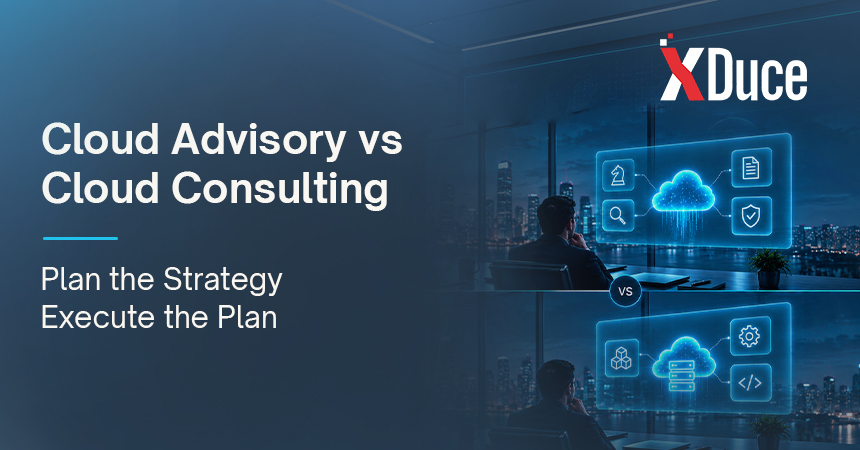
In practice, the two terms overlap heavily, and many firms use them interchangeably. Where a distinction does exist, it usually comes down to how strategic versus hands-on the work is:
| Factor | Cloud Advisory Services | Cloud Consulting |
|---|---|---|
| Primary focus | Strategy, planning, and direction | Strategy plus hands-on technical delivery |
| Typical output | Assessment, roadmap, governance framework | Architecture design, build, and implementation |
| Best for | Deciding what to do and why | Executing the plan once it’s set |
| Team involved | Strategists and platform architects | Engineers, architects, and delivery teams |
This isn’t a hard rule. Some cloud advisory consultants stay purely strategic and hand off execution to another team. Others, including full-service providers like XDuce, offer both under one roof so the strategy doesn’t get lost in translation between the people who planned it and the people who build it, whether that involves a broader cloud consulting company or a dedicated advisory-only team.
The Cloud Advisory Process Step by Step
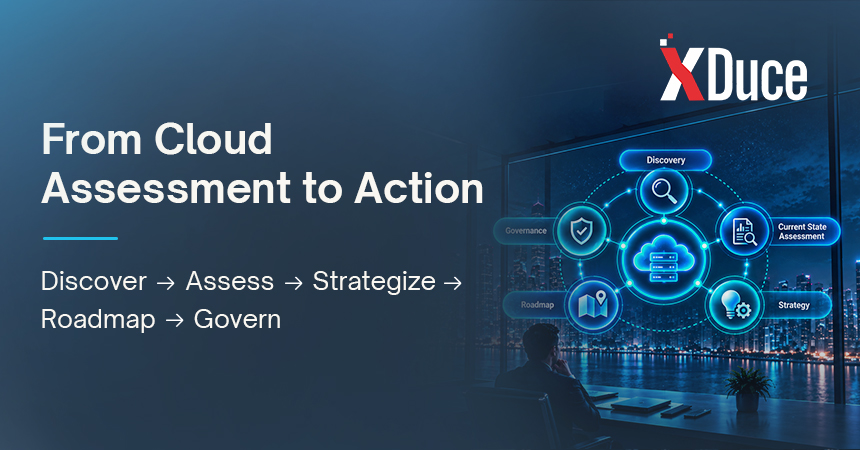
Most engagements move through a similar sequence, regardless of which provider you work with:
- Discovery. The advisor sits down with stakeholders across IT, finance, and business leadership to understand goals, constraints, and where the current setup is causing pain. This stage sets the scope for everything that follows.
- Current state assessment. The team maps existing infrastructure, applications, spending, and security gaps, usually working from actual usage data and cost reports rather than assumptions, to get an honest picture of what’s really running.
- Strategy definition. Based on the assessment, the advisor recommends a platform, deployment model, and set of priorities, weighing trade-offs like cost, compliance, and performance against what the business actually needs.
- Roadmap development. The strategy gets broken into phases with realistic timelines and dependencies, so the business ends up with a concrete plan instead of a general direction.
- Governance framework design. Policies for cost control, security, and access get defined before the environment scales further, which heads off the kind of sprawl that’s expensive to unwind later.
- Ongoing advisory. The relationship doesn’t have to end at handoff. Many businesses keep the advisor engaged periodically to revisit the strategy as the business, the workloads, and the platforms themselves evolve.
AWS, Azure, or Multi-Cloud: Where Advisory Work Earns Its Keep
Platform selection is one of the highest-stakes decisions in any cloud engagement, and it’s also one businesses get wrong more often than they realize. A few patterns tend to hold:
- Businesses already invested in the Microsoft ecosystem often lean toward Azure cloud consulting services for tighter integration with existing tools
- Businesses prioritizing the widest range of managed services and third-party tooling often lean toward AWS cloud consulting services
- Multi-cloud strategies make sense for large enterprises with regulatory, redundancy, or vendor-diversification requirements, but they add real operational complexity
- Very few small or mid-sized businesses need multi-cloud from day one, even though it gets pitched as a best practice
A good cloud advisory consultant will push back on multi-cloud by default and only recommend it when the business case genuinely supports the added complexity.
Why Enterprises Bring in Cloud Advisory Before Migration or Modernization
Skipping the advisory phase and jumping straight into migration is one of the most common, and most expensive, mistakes enterprises make. A proper advisory engagement upfront tends to prevent:
- Migrating workloads to a platform that doesn’t actually fit the business’s compliance or performance needs
- Underestimating the cost of running the new environment at scale
- Missing dependencies between applications that only surface mid-migration
- Security gaps that get discovered during an audit instead of before go-live
- Rebuilding the same roadmap eighteen months later because nobody defined one the first time
Cloud Advisory Services vs. Managed Cloud Services
These two get confused often enough that it’s worth a direct answer. Cloud advisory services are about deciding what to do and mapping how to get there. Managed cloud services are about running the environment day to day once it exists, covering monitoring, patching, and support:
| Factor | Cloud Advisory Services | Managed Cloud Services |
|---|---|---|
| Core question | What should we do, and how do we get there? | Who runs this day to day? |
| Timing | Before or during a major decision | Ongoing, once the environment is live |
| Activities | Assessment, strategy, roadmap, governance | Monitoring, patching, support, incident response |
| Engagement length | Project-based or periodic | Continuous, usually a retainer |
| When you need it | Planning a migration, modernization, or platform switch | Running a stable environment day to day |
Most businesses need both at different points, often starting with advisory and transitioning into managed services once the strategy is set.
Signs Your Business Needs a Cloud Advisory Consultant
A few situations tend to be strong signals that outside strategic help is worth the investment:
- Cloud spending keeps climbing without a clear explanation why
- There’s no documented cloud strategy, just a series of decisions made under deadline pressure
- Leadership is considering a major migration or platform switch and wants a second opinion
- Different teams are making conflicting architecture decisions with no central governance
- A compliance requirement or audit has exposed gaps nobody had a plan to address
What a Cloud Advisory Consultant Delivers at Each Stage
It helps to see what tangible output comes out of each phase, rather than treating advisory work as an abstract exercise:
| Stage | Typical Deliverable | Business Outcome |
|---|---|---|
| Discovery | Stakeholder interviews, goals summary | Shared understanding of what success looks like |
| Assessment | Infrastructure and cost audit report | A clear picture of what is working and what is not |
| Strategy | Platform recommendation and business case | Confidence in the direction before spending on it |
| Roadmap | Phased implementation plan with milestones | A realistic path instead of a vague ambition |
| Governance | Policy framework for cost, access, and security | Consistency as more teams start using the cloud |
Industries That Lean Most Heavily on Cloud Advisory Services
While any business can benefit from strategic cloud guidance, a few industries tend to invest in it earliest, usually because the cost of getting it wrong is especially high:
| Industry | Why It Invests Early | Real-World Example |
|---|---|---|
| Financial Services | Regulatory requirements shape nearly every architecture decision | A regional bank restructuring its cloud environment to meet updated data-residency rules ahead of a core banking system migration |
| Healthcare | Compliance and data protection carry legal weight, not just operational risk | A healthcare provider mapping its infrastructure against HIPAA requirements before moving patient records to the cloud |
| Insurance | Legacy systems and modern data needs constantly pull in different directions | An insurer building a roadmap to modernize claims processing without disrupting policies still running on decades-old systems |
| Retail & E-commerce | Seasonal demand spikes punish an under-planned architecture | A retailer stress-testing its cloud architecture ahead of a holiday sales surge to avoid the outages that hit competitors the year before |
| Manufacturing | Supply chain visibility and IoT data need a scalable, secure cloud foundation | A manufacturer building a cloud strategy to connect plant-floor IoT sensors with enterprise planning systems |
| Government & Public Sector | Strict security, data sovereignty, and procurement requirements shape every decision | A public agency evaluating a FedRAMP-aligned cloud environment before migrating citizen-facing services |
| Technology & SaaS | Fast growth and multi-tenant architecture demand scalable, cost-efficient design | A SaaS company redesigning its cloud architecture to support rapid customer growth without costs spiraling |
| Education | Distributed campuses and student data privacy require careful planning | A university system rolling out a hybrid cloud environment across multiple campuses while meeting FERPA requirements |
Red Flags to Watch For in a Cloud Advisory Engagement
A few warning signs suggest an advisory engagement is more sales pitch than substance:
- The recommendation happens to match whichever platform the firm is a partner for, regardless of your specific needs
- The roadmap has no phases or milestones, just a general direction
- Nobody asks about your compliance requirements before recommending an architecture
- The engagement produces a report but no follow-up conversation about execution
- Cost projections are vague or presented without a clear methodology behind them
How Cloud Advisory Fits Into a Larger Digital Transformation
Cloud advisory rarely happens in isolation. For most enterprises, it’s one piece of a broader effort to modernize how the business operates, alongside application modernization, data strategy, and sometimes AI adoption. Treating cloud advisory as a standalone technical exercise, disconnected from those wider goals, tends to produce a technically sound plan that doesn’t actually move the business forward. The strongest engagements tie every recommendation back to a business outcome, not just a technical improvement.
What to Look For When Evaluating a Cloud Advisory Consultant
A short evaluation checklist tends to separate a strong fit from a mismatch:
- Ask for examples of past engagements in your industry or at a similar company size
- Confirm whether the recommendation process is platform-neutral or tied to a specific vendor partnership
- Clarify what happens after the strategy is delivered, including whether implementation support is included
- Ask how they measure success, and whether that includes cost, performance, or both
- Request a sample deliverable or table of contents from a past engagement, if possible
How Much Do Cloud Advisory Services Cost
Pricing varies widely depending on scope. A focused assessment and roadmap for a single business unit might run as a fixed-fee project measured in weeks. An enterprise-wide strategic engagement covering multiple platforms, compliance frameworks, and business units can run considerably longer and is usually priced accordingly. A few factors tend to move the number most:
- The size and complexity of the current environment being assessed
- Whether the engagement includes only strategy or also hands-on implementation support
- How many stakeholders and business units need to be involved in discovery
- Whether compliance requirements add extra documentation and review cycles
Building an Internal Advisory Function vs. Bringing in Outside Help
Some large enterprises eventually build an internal cloud center of excellence to handle this work permanently. That path makes sense once cloud decisions are frequent enough, and the business is large enough, to justify dedicated headcount purely for strategy. For most businesses, though, the volume of major cloud decisions in any given year isn’t high enough to justify a full-time internal advisory team, which is why outside cloud advisory services tend to be the more practical choice, brought in specifically when a major decision is on the table rather than kept on staff year-round.
Whichever path a business takes, the underlying goal stays the same: making sure technical decisions serve the business, not the other way around.
Frequently Asked Questions
Cloud advisory tends to describe the strategic, planning-focused work, while a broader cloud consulting company may also handle hands-on technical delivery. Many firms use the terms interchangeably.
Enterprises use advisory services most often because of the complexity involved, but smaller businesses considering a major cloud decision can also benefit from a focused, lower-cost advisory engagement.
A cloud advisory consultant typically stays platform-neutral and helps you decide which platform fits your business, while AWS cloud consulting services or Azure cloud consulting services usually focus on implementation within that specific platform.
A focused assessment and roadmap can take a few weeks. A full enterprise strategic engagement covering multiple business units and compliance requirements often takes longer, depending on scope.
Many can, either directly or through a coordinated handoff to an implementation team. It’s worth confirming this upfront, since some advisory firms are strategy-only.
Jumping straight into migration without a documented strategy, which often leads to cost overruns, security gaps, and a roadmap that has to be rebuilt after the fact.
It depends on your situation. If you’re already committed to AWS or Azure, a specialist can go deeper. If you’re still deciding on a platform, a vendor-neutral advisor is usually a better starting point.
It depends on volume. Businesses making frequent, major cloud decisions may eventually justify a dedicated internal team, but most businesses see more value bringing in outside cloud advisory services for specific decisions rather than staffing this function year-round.
A strong report includes a current state assessment, a platform and architecture recommendation grounded in your data, a phased roadmap with milestones, and a governance framework, not just a general direction.
Related Blogs