Introduction
A lot of cloud strategies are not really strategies. They are a collection of decisions made under deadline pressure, stitched together after the fact and called a plan. That approach can carry a business for a while, but it tends to fall apart exactly when it matters most: during a major migration, a compliance audit, or a period of fast growth. Building a real cloud strategy means starting with the business, not the technology, and working outward from there.
This guide walks through a practical, step-by-step approach to building a cloud strategy that actually holds up once budgets, deadlines, and real usage patterns are in the mix, not just one that looks good in a planning document.
Involve the Right Stakeholders Early
A cloud strategy built entirely by IT tends to miss business context. A strategy built entirely by business leaders tends to miss technical reality. The strongest strategies come from bringing the right people into the room from the start:
- Finance, to weigh in on budget constraints and cost expectations early rather than after the plan is set
- Security and compliance, to flag regulatory requirements before they become a late-stage blocker
- The teams who will actually operate the environment day to day, not just the ones designing it
- Business unit leaders whose workflows will be affected by the changes
Start With Business Objectives, Not Technology
It is tempting to start a cloud strategy conversation with a platform comparison. Resist that. The better starting point is a plain-language list of what the business actually needs to accomplish over the next one to three years, whether that is entering a new market, passing a compliance audit, cutting operating costs, or simply surviving a growth spurt without the infrastructure falling over. Every technical decision that follows should trace back to one of these goals.
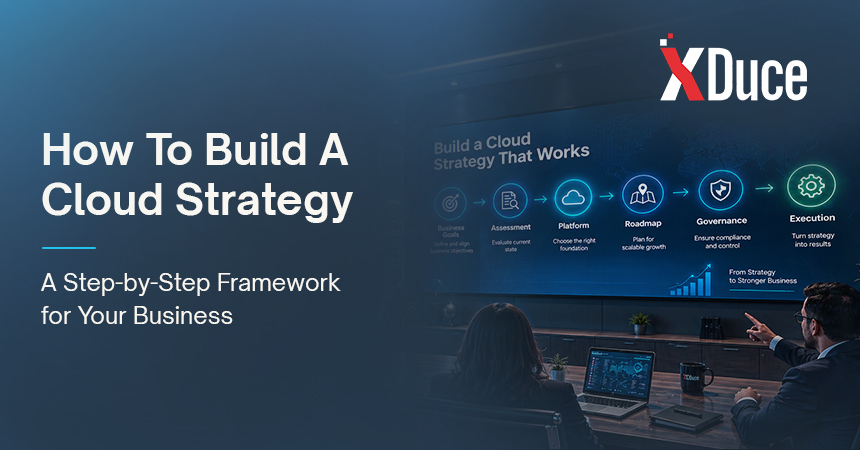
Step 1: Assess Your Current Environment
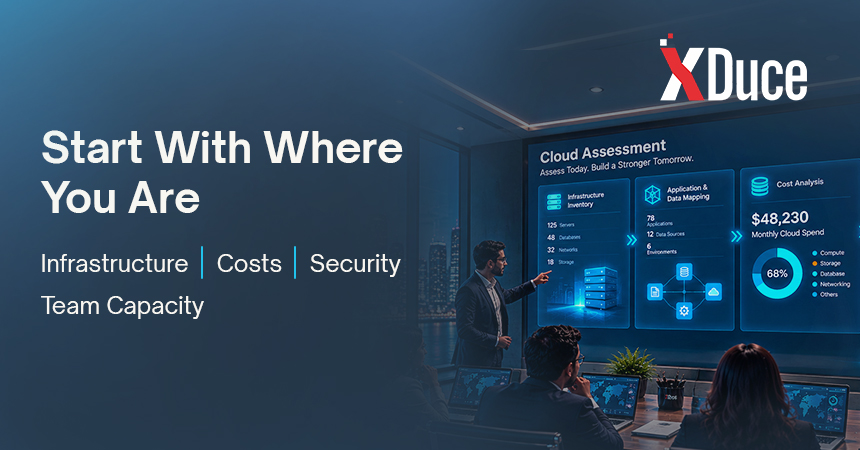
Before deciding where to go, get an honest read on where you actually are. This step usually covers:
- An inventory of current infrastructure, applications, and data stores
- A cost review, including what is being paid for versus what is actually being used
- A security and compliance gap analysis against your industry’s requirements
- An honest assessment of internal team skills and capacity
Step 2: Define Your Cloud Goals and Success Metrics
Vague goals like “modernize our infrastructure” are hard to plan against and impossible to measure. Translate broad ambitions into specific, trackable targets:
- Reduce infrastructure spend by a specific percentage within a defined timeframe
- Cut deployment time for new features from weeks to days
- Achieve a named compliance certification by a set date
- Support a defined increase in user or transaction volume without a performance drop
Step 3: Choose the Right Platform and Deployment Model
This decision should follow from the goals defined above, not the other way around. A quick reference for how the major options tend to line up:
| Option | Best Fit For | Trade-Off to Expect |
|---|---|---|
| AWS | Broadest range of managed services and third-party integrations | More configuration choices to manage |
| Azure | Businesses already invested in Microsoft tools and identity systems | Fewer niche managed services than AWS in some categories |
| Hybrid cloud | Businesses with legacy systems that cannot fully move yet | More operational complexity to manage across environments |
| Multi-cloud | Large enterprises with redundancy or regulatory requirements | Meaningfully higher operational and governance overhead |
If part of the roadmap involves modernizing older systems so they actually run well on the new platform, that work is usually scoped as a separate application modernization effort rather than folded into the platform decision itself.
Step 4: Build a Phased Roadmap
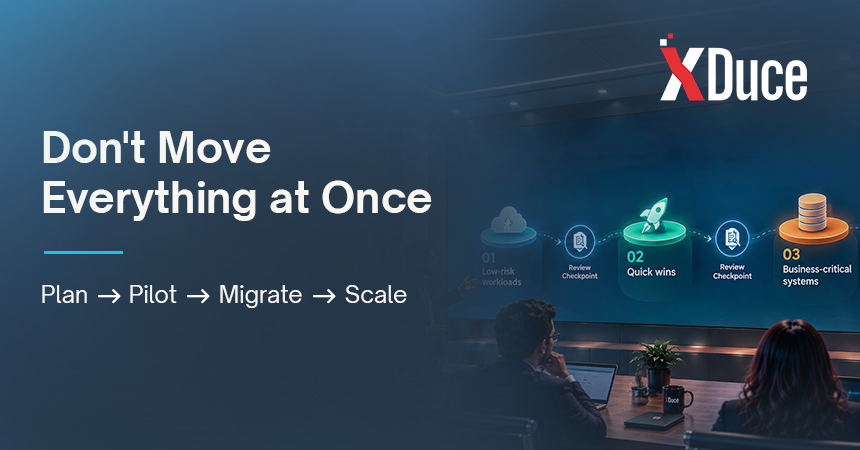
Trying to move everything at once is one of the most common ways cloud strategies fail in execution. A phased approach spreads risk and lets the team learn from earlier phases before tackling harder ones:
- Move low-risk, low-complexity workloads first to validate the approach
- Address any quick wins that free up budget or capacity for later phases
- Tackle the most business-critical systems once the team has momentum and lessons learned
- Save the most complex, tightly coupled legacy systems for the final phase, once patterns are established
- Build in review checkpoints between phases rather than committing to the entire plan upfront
Step 5: Establish Governance and Cost Controls
A strategy without governance tends to drift within the first year. Put a few basics in place before scaling usage:
- A consistent resource tagging policy so costs can be tracked by team or project
- Approval workflows for provisioning anything above a defined cost threshold
- Regular cost reviews, not just an annual audit after the budget has already been blown
- Clear ownership for security policy, so it does not fall between teams
For businesses without a dedicated internal security function, this ownership question is often where outside cybersecurity expertise fills the gap, rather than leaving policy decisions to whoever happens to notice a problem first.
Common Cloud Strategy Mistakes to Avoid
A few patterns show up again and again in strategies that do not hold up:
- Choosing a platform based on what a competitor uses rather than your own requirements
- Skipping the cost review until after the first full month’s invoice arrives
- Building a roadmap with no phases, planning for a single all-at-once migration
- Treating governance as something to add later instead of building it in from the start
- Writing the strategy once and never revisiting it as the business changes
Getting Outside Help When Building Your Strategy
Internal teams often have deep knowledge of the business but limited bandwidth or platform expertise to build a strategy from scratch while also keeping daily operations running. Cloud advisory services exist for exactly this gap, bringing an outside, platform-agnostic view to the assessment and roadmap phases without the internal politics that can bog down a purely in-house process.
Once the strategy and roadmap are actually set, many businesses pair that work with managed cloud services to handle the operational side, monitoring, patching, and day-to-day support, so the plan does not stall out once the assessment phase wraps up.
How to Budget for a Cloud Strategy
Budgeting for cloud work upfront tends to be more accurate than budgeting after the fact, since costs are easier to estimate before commitments are made than to unwind once they exist. A realistic budget usually accounts for:
- The cost of the assessment and strategy work itself, whether done internally or with outside help
- Migration or implementation costs for each phase of the roadmap
- Ongoing operating costs once workloads are live, including backup and disaster recovery coverage, not just the one-time move
- A contingency buffer for the unknowns that surface once real usage data comes in
Reviewing and Updating Your Strategy Over Time
A cloud strategy is not a document you write once and file away. Platforms release new services, business priorities shift, and usage patterns evolve. A simple cadence keeps the strategy useful instead of stale:
- Review cost and performance metrics against the original goals every quarter
- Revisit the roadmap itself at least once a year, or after any major business change
- Reassess platform fit whenever a major new requirement emerges, like a new compliance obligation
- Retire or update goals that are no longer relevant instead of leaving them unaddressed
A Quick Pre-Launch Checklist
Before kicking off execution on any phase of the roadmap, a short gut check helps catch gaps early:
- Have the business goals for this phase been clearly defined and agreed on
- Has the current environment been assessed with real data, not assumptions
- Does the roadmap have realistic milestones with named owners
- Is governance, including tagging and cost alerts, set up before workloads go live
- Has a rollback plan been discussed in case something does not go as expected
A Sample Cloud Strategy Framework
A useful way to organize the finished strategy is around four pillars, each with its own focus and example initiatives:
| Pillar | Focus | Example Initiative |
|---|---|---|
| Cost | Spend efficiency and predictability | Rightsizing review and reserved capacity planning |
| Security | Protecting data and meeting compliance | Identity and access management overhaul |
| Scalability | Supporting growth without rework | Auto-scaling architecture for peak demand periods |
| Innovation | Enabling new capabilities | Adopting managed AI or data services where they add value |
Getting Buy-In Beyond the IT Department
A technically sound strategy still fails if the rest of the business does not buy into it. Getting genuine buy-in usually means translating the plan into terms each stakeholder actually cares about: cost predictability for finance, risk reduction for compliance, and minimal disruption for the teams whose daily workflows will change. A strategy presented purely in technical language tends to get nodded through in a meeting and then quietly ignored once budget season arrives.
Tools That Help Track Strategy Execution
A strategy is only as good as the visibility you have into whether it is actually being followed. Most teams end up relying on a mix of native cloud cost dashboards, tagging reports, and a shared roadmap tracker that stays visible to stakeholders outside IT, not just the engineering team. The specific tools matter less than the habit of checking them regularly rather than building them once and letting them go stale. A strategy that only lives in a slide deck from the kickoff meeting is not really being executed, no matter how good it looked on the day it was approved.
Who Should Actually Own the Cloud Strategy
Ownership matters as much as content. A strategy with no clear owner tends to drift, revisited only when something breaks. In most organizations, a single accountable owner, whether that is a CTO, a VP of infrastructure, or an external cloud advisory services partner reporting into leadership, keeps the strategy alive between major milestones rather than letting it become a document nobody revisits until the next crisis forces the conversation.
Related Reading
For a broader look at what this kind of engagement actually covers, see our pillar guide on what cloud advisory services are. If you are trying to decide between a project-based engagement and ongoing support, our breakdown of cloud consulting vs managed services walks through that decision directly. And if cost is the main driver behind revisiting your strategy, our guide to cloud advisory for enterprise cost optimization goes deeper on that specific angle.
Frequently Asked Questions
It depends heavily on scope. A focused strategy for a single business unit, covering just the assessment and a phased roadmap, can often be built in two to four weeks. A full enterprise strategy that spans multiple business units, several compliance frameworks, and a platform decision typically takes longer, sometimes a couple of months, mainly because stakeholder alignment and a thorough current-state assessment take real time to do properly.
No, and treating it that way is one of the more common ways strategies go stale. Platforms release new services, pricing models shift, and business priorities change, sometimes within the same year the strategy was written. Building in a regular review cadence, quarterly for cost and performance, annually for the roadmap itself, keeps the plan useful instead of becoming a document nobody opens again after the kickoff meeting.
Most small and mid-sized businesses are better served by committing to one primary platform, since it keeps operational complexity and governance manageable with a smaller team. Multi-cloud setups make more sense for large enterprises with specific redundancy, regulatory, or vendor-diversification requirements, but the added operational overhead is real, so it is worth confirming the business case is genuinely there before committing to it by default.
Start with business objectives, not technology. Before comparing platforms or sketching an architecture diagram, write down in plain language what the business actually needs to accomplish over the next one to three years, whether that’s entering a new market, passing a compliance audit, or cutting operating costs. Every technical decision that follows should trace back to one of those goals rather than the other way around.
Check it against the measurable goals set at the start, things like cost targets, deployment speed, or a specific compliance milestone, rather than relying on a general sense that things feel fine. If nobody can point to a specific number that has moved since the strategy was written, that’s usually a sign the strategy exists on paper but isn’t actually being tracked or executed against.
Often yes, and it’s rarely about the internal team lacking skill. Internal teams tend to have deep knowledge of the business but limited bandwidth to step back and build a full strategy while also keeping daily operations running, and they may not have hands-on experience with every platform under consideration. Outside cloud advisory services bring a platform-neutral view and the time to do a proper assessment, which internal teams often can’t spare.
Decisions get made ad hoc and under deadline pressure, one team spins up resources one way, another team does it differently, and nobody is tracking the cumulative effect. Over time that tends to produce inconsistent architecture, unpredictable costs, and governance gaps that only get discovered during a security audit or a major outage, which is exactly the worst possible time to find them.
Cost and performance metrics are worth checking against the original goals every quarter, since drift tends to show up gradually rather than all at once. The roadmap itself is worth a full review at least once a year, or sooner if the business goes through a major change like an acquisition, a new compliance requirement, or a significant shift in growth plans.
Translate the plan into terms each stakeholder actually cares about rather than presenting it in purely technical language. That usually means framing cost predictability for finance, risk reduction for compliance and security, and minimal disruption for the operational teams whose daily workflows will be affected. A strategy pitched only in architecture terms tends to get a polite nod in the meeting and then get quietly ignored once budget season arrives.

Related Blogs