Introduction
If you have spent any time researching IT infrastructure lately, you have probably run into the phrase “cloud services provider” more times than you can count. And here is the annoying part: it gets used loosely. Sometimes people mean a hosting company. Sometimes they mean a full technology partner. Sometimes it just means whoever sold them storage space last year. That inconsistency makes it genuinely hard to know what you are signing up for before you sign anything.
So let us slow down and actually answer the question. In this guide, we will cover:
- What a cloud services provider actually does
- What a working relationship with one actually looks like
- How businesses across the United States, from five-person startups to sprawling enterprises, use one to run leaner and safer operations
If you are just starting to explore your first move to the cloud, or you are an IT leader quietly wondering if your current setup is holding you back, this one is for you.
What is a Cloud Services Provider?
At its core, a cloud services provider is a company that delivers computing resources, things like servers, storage, networking, and software, over the internet instead of through hardware sitting in your office or a rented rack down the street. Instead of buying physical servers, managing a data center, or hiring a big internal team to babysit all of it, you access what you need on demand while the provider handles the messy parts behind the scenes.
Here is a simple way to picture it. You do not generate your own electricity to run your business. You just plug into the grid and pay for what you use. Cloud computing works the same way, just with computing power instead of electricity.
Most providers offer some mix of the following:
- Infrastructure as a Service (IaaS): virtual servers, storage, and networking you can spin up in minutes
- Platform as a Service (PaaS): a ready-made environment for developers to build and ship applications
- Software as a Service (SaaS): finished applications delivered straight over the internet
- Managed cloud services: the ongoing monitoring, upkeep, and support that keeps everything running smoothly after launch
Some providers stick to renting out infrastructure and nothing more. Others go further. XDuce, for example, operates as a full cloud computing service provider, which means the conversation starts with strategy and security long before anything actually moves.
What Does a Cloud Services Provider Actually Do, Day to Day?
Definitions only get you so far. It helps more to look at what this partnership actually looks like once the contract is signed. A solid cloud services provider generally covers five areas:
- Strategy and planning first. Before a single workload moves anywhere, a good provider takes the time to understand what you are running today, what you are trying to accomplish, and what your budget realistically allows. Businesses often want to skip this step. Don’t. It is usually the difference between a smooth migration and a six-month headache.
- Migration. This is the actual process of moving your applications, data, and workloads out of on-premises servers or aging legacy systems and into a cloud environment, whether that is AWS, Microsoft Azure, Google Cloud Platform, or some hybrid combination of the three.
- Cost optimization. Cloud bills have a funny way of ballooning if nobody is paying attention. Ongoing optimization means someone is regularly checking that you are not paying for capacity you never actually use.
- Security and compliance. This is where a cloud security consultant earns their keep, especially if your business operates in a regulated space like healthcare, finance, or government contracting. More on this in a bit.
- Management and support that does not disappear after launch. Systems need patching, monitoring, backups, and the occasional 2 a.m. fix long after the migration party is over. This is the part that quietly determines whether your cloud setup stays healthy or slowly turns into a mess nobody wants to touch.
Cloud Services Provider vs. Cloud Computing Service Provider: Does It Matter?
Honestly, most people use these two terms interchangeably, and for everyday purposes that is fine. A cloud computing service provider and a cloud services provider both deliver computing resources and support over the internet.
If there is a subtle difference worth knowing, it is this. “Cloud computing service provider” tends to lean toward the technical infrastructure, the servers, storage, and processing power. “Cloud services provider” is often the broader umbrella, covering the strategy, consulting, and ongoing management wrapped around that infrastructure. In practice, the businesses that get the most out of this relationship are usually working with a partner who covers both sides rather than picking one and hoping the rest works itself out.
Why Enterprises Actually Need One of These
Enterprise IT in the United States has only gotten messier over the last few years, not simpler. Hybrid work, stricter data regulations, and customers who expect near-instant everything have made the case for a dedicated cloud partner much harder to brush off.
Here is what cloud services for enterprises tend to solve for in practice:
- Scalability without overspending on hardware you might not need in six months. Enterprises deal with unpredictable demand all the time, whether that is seasonal spikes, sudden expansion into a new market, or the fallout from a merger. Cloud infrastructure lets you flex up or down without a purchase order for equipment that might sit half-used.
- Business continuity that does not fall apart during a bad week. A properly built cloud environment includes backup and disaster recovery baked in from the start, so a hardware failure or regional outage does not grind the whole business to a halt.
- Faster innovation. Teams that used to wait months to provision new infrastructure can now spin up an environment in days. That speed matters a lot when you are racing a competitor to market.
- Regulatory compliance that is not an afterthought. Industries like healthcare, financial services, and government contracting live under frameworks like HIPAA, SOC 2, and NIST. A provider who has done this before builds compliance into the architecture from day one instead of bolting it on later and hoping for the best.
- Modernizing the legacy systems nobody wants to touch. Plenty of enterprises are still quietly running critical operations on software that predates the cloud entirely. A provider experienced in application modernization can help retire that technical debt without blowing up the business in the process.
Cloud Services for Small Business: Not Just an Enterprise Story
It is tempting to assume cloud transformation only matters if you have a big budget and a bigger IT department, but that assumption stopped holding up a while ago. Small and mid-sized businesses across the country are turning to cloud solutions for small businesses for reasons that are just as practical as anything an enterprise deals with.
For a smaller company, the appeal usually comes down to a few things:
- Cost predictability. This matters a lot when you do not have a large capital budget sitting around, and cloud services typically run on a subscription or usage-based model rather than a giant upfront purchase.
- No need for a large in-house IT team. A managed provider can cover monitoring, security, and day-to-day support instead, which takes a real burden off a small staff.
- Room to grow without guessing. Because cloud infrastructure flexes with you, a small business can grow into more capacity as it is actually needed, instead of overbuying today based on a guess about demand two years out.
The businesses that get this right tend to start small. They migrate whatever matters most first, then build out from there, working with a provider who genuinely understands their size and their pace instead of treating them like a smaller version of an enterprise client.
What a Cloud Security Consultant Actually Does
Security is usually the first worry businesses raise before moving anything to the cloud, and honestly, that instinct is correct. A breach, a ransomware incident, or a compliance failure can cost far more than the migration itself ever would.
A cloud security consultant is a specialist focused entirely on protecting your cloud environment. Their work generally includes:
- Assessing vulnerabilities before and during migration
- Setting up identity and access management, along with multi-factor authentication
- Configuring encryption for data both at rest and in transit
- Building in monitoring and threat detection
- Aligning your setup with whatever framework applies to you, whether that is SOC 2, HIPAA, or NIST
- Running regular audits so small gaps get caught before they turn into real incidents
Working with a provider who treats cloud security consulting as part of the core service, not a bolt-on add-on, gives you a much sturdier foundation. XDuce’s managed IT and cybersecurity team, for instance, has maintained SOC 2 Type II certification through recurring independent audits, which says something about the level of discipline this kind of work actually requires.
How to Actually Choose a Cloud Services Provider
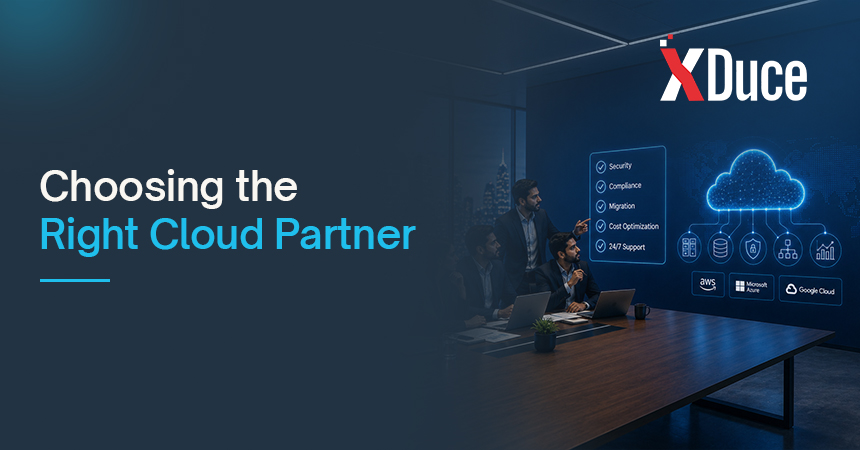
With so many vendors saying almost the same thing, it helps to have a short list of questions that cut through the sales pitch:
- Do they understand your industry, or are they learning on your dime? A healthcare organization and a manufacturing company have wildly different compliance and performance needs. A provider with relevant experience asks sharper questions upfront and catches risks faster.
- Do they cover the whole picture, or just one piece of it? Some vendors handle migration and vanish afterward. Others offer infrastructure with zero strategic guidance. You want a partner who covers planning, migration, security, and the long haul of ongoing management.
- What is their track record with businesses your size? A provider built around enterprise clients might drown a small business in unnecessary complexity, and the reverse is just as true.
- How do they actually handle security and compliance? Ask directly about certifications, past audits, and how they would approach whatever regulation applies to your business specifically.
- What does support look like when something breaks at 6 p.m. on a Friday? Find out whether you get a dedicated team, a ticketing queue, or something in between, and what their real response times look like.
Mistakes Businesses Keep Making With Cloud Partners
A few patterns show up again and again among businesses that end up unhappy with their setup:
- Treating migration as a single project instead of an ongoing relationship. A cloud environment needs continuous attention. It is not something you finish and forget.
- Underestimating what it costs to do nothing. Sticking with old infrastructure often ends up costing more in maintenance, downtime, and missed opportunity than migrating would have in the first place.
- Choosing a provider purely on price. Without checking whether they actually have the security depth and industry experience your business needs, this one tends to be the most expensive mistake of the three.
Why Businesses Across the United States Work With XDuce
XDuce has spent nearly two decades helping organizations, from growing small businesses to large enterprises, rethink how they run their technology. As a cloud services provider, XDuce works across AWS, Microsoft Azure, and Google Cloud Platform, bringing together cloud strategy, migration, cloud-native application development, managed operations, and security consulting under one roof instead of scattering it across three different vendors.
That means you are not stitching together separate providers for strategy, migration, and security and hoping they talk to each other. You get one partner who sees the whole picture, backed by a team recognized on the MSP 501 list and certified through SOC 2 Type II audits. You can read more about how XDuce approaches this work on the digital transformation and about pages.
Final Thoughts
Picking a cloud services provider is not just an IT checkbox. It shapes how fast your business can move, how safely your data is handled, and how much you end up spending down the road. Whether you are an enterprise team wrestling with compliance requirements or a small business hunting for cloud solutions for small businesses that actually fit your budget, the right partner makes that whole decision a lot less stressful.
Frequently Asked Questions
A hosting company usually just rents you server space to run a website or application. A cloud services provider goes much further, offering infrastructure, security, migration support, and ongoing management built around your actual business needs.
It varies a lot based on your business size, the complexity of your systems, and how much support you need. Most providers use usage-based pricing, so small businesses can start modest and scale up as they grow rather than committing to a huge upfront cost.
Yes, as long as it is set up properly. A cloud security consultant makes sure your environment includes encryption, access controls, and compliance measures suited to whatever regulation applies, whether that is HIPAA, SOC 2, or NIST.
It depends on how big and tangled your systems are, but many mid-sized migrations run anywhere from a few weeks to a few months. Moving the most critical systems first, rather than everything at once, tends to lower the risk quite a bit.
Yes, and more than most people expect. A lot of cloud solutions for small businesses run on the same underlying infrastructure enterprises use, just scaled and priced to fit. That gives smaller companies access to a level of security and reliability that used to be out of reach.

Related Blogs