Introduction
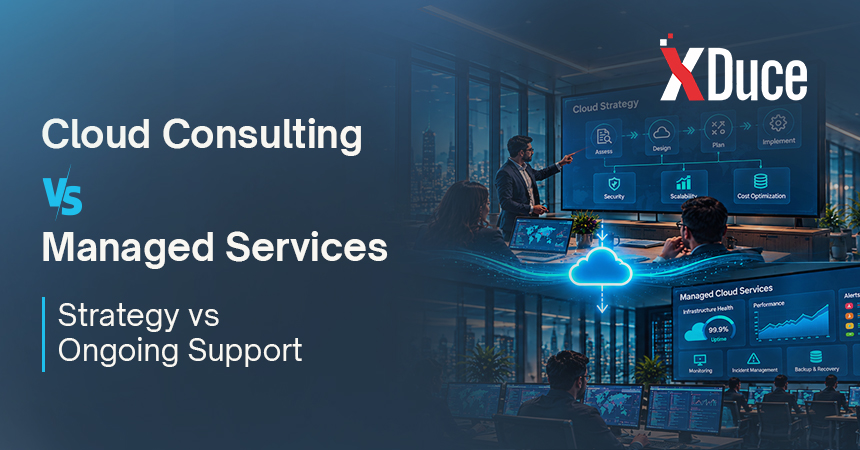
Cloud consulting and managed services get lumped together so often that a lot of businesses assume they’re buying the same thing under two different names. They’re not. One is about figuring out what to do. The other is about doing it, day after day, once the plan is already in motion. Mix the two up and you end up with an expensive mistake: paying for a consulting engagement when what you really needed was ongoing operational support, or the reverse.
This guide walks through what each one involves, where they differ on cost and timing, and how to tell which one (or which combination) your business needs right now.
Cloud Consulting vs Managed Services Side by Side
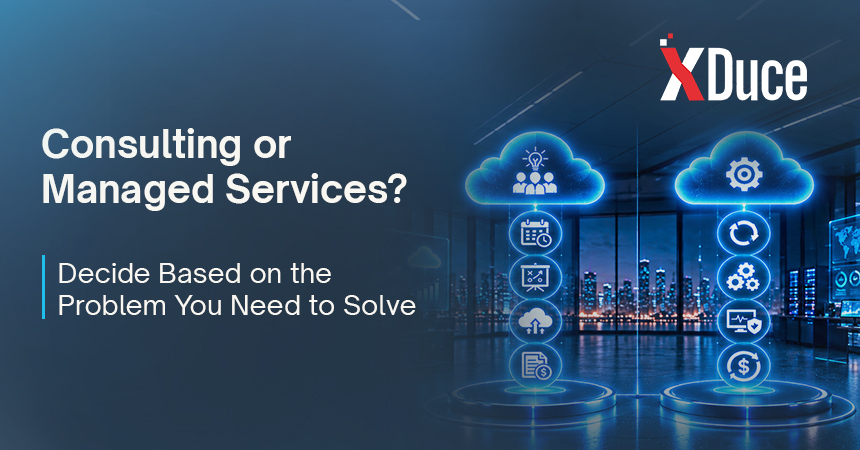
Putting the two next to each other makes the distinction easier to act on:
| Factor | Cloud Consulting | Managed Services |
|---|---|---|
| Duration | Fixed-term engagement with a defined end date | Ongoing, open-ended relationship |
| Primary goal | Decide what to do and build a plan | Keep the environment running day to day |
| Typical trigger | A migration, modernization, or major decision | A live environment that needs continuous support |
| Pricing model | Project-based or fixed fee | Monthly or tiered recurring fee |
The Pros and Cons of Cloud Consulting and Managed Services
| Cloud Consulting | Managed Services |
|---|---|
| Pro: Outside, platform-neutral expertise for specific decisions or projects | Pro: Continuous coverage, including nights, weekends, and holidays when scoped |
| Pro: Defined scope and end date make costs more predictable | Pro: Predictable monthly costs instead of unexpected emergency support bills |
| Pro: Hands-on architecture work, not just recommendations or slide decks | Pro: Provider becomes deeply familiar with your environment over time |
| Con: No ongoing day-to-day support after the engagement ends | Con: Not designed primarily for major strategic decisions, such as choosing a new platform |
| Con: Knowledge can leave with consultants if documentation is limited | Con: Switching providers can be more disruptive than changing consultants |
What Cloud Consulting Involves
A cloud consulting company is usually brought in for a defined engagement with a clear start and end. The work typically covers:
- Assessing current infrastructure and flagging gaps or risks
- Recommending a platform, architecture, or migration approach
- Mapping out a roadmap for a specific initiative, like a migration or modernization project
- Hands-on architecture or implementation help for that initiative
- Handing off documentation and knowledge transfer once the engagement wraps
What Managed Services Involves
Managed services are open-ended by design, no fixed end date. A typical scope covers:
- 24/7 or business-hours monitoring of your cloud environment
- Patching, updates, and routine maintenance
- Responding when something breaks
- Ongoing cost monitoring and rightsizing
- Regular reporting on performance, uptime, and spend
When to Choose Cloud Consulting
Consulting is usually the right call when the problem in front of you is a decision, not a staffing gap:
- You’re planning a major migration and need a strategy before touching anything
- You’re weighing AWS against Azure, or a multi-cloud approach, and want an outside opinion
- Your architecture needs a redesign but daily operations are otherwise stable
- You need a one-time security or compliance assessment
When to Choose Managed Services
Managed services usually make more sense when the gap is capacity, not direction:
- Your environment is already built and just needs reliable day-to-day support
- Your internal team is stretched too thin to handle monitoring and incident response
- You’d rather pay predictable monthly costs than get hit with emergency support bills
- You need coverage outside normal business hours that your internal team can’t provide
Can You Use Both Together
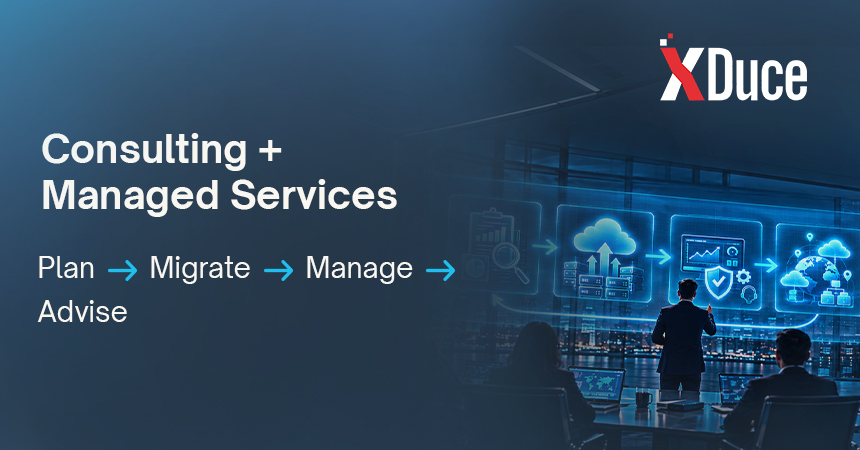
Yes, and honestly this is one of the more common paths businesses end up on. A typical sequence looks something like this:
- Start with a consulting engagement to assess the current environment and define a strategy
- Use that same engagement to plan and execute a migration or modernization project
- Move into managed services once the new environment is live, to keep it running smoothly
- Come back to consulting periodically for major decisions, like adding a new platform or region
Cost Differences Between Consulting and Managed Services
Consulting is usually priced as a project or fixed fee tied to a defined scope, so you know the total cost upfront, but it ends when the engagement does. Managed services runs as a recurring monthly fee, which spreads the cost out predictably but keeps going for as long as the relationship does. Neither one is automatically the cheaper option. It really comes down to whether you’re solving a one-time problem or an ongoing one.
Typical Cost Structure
Cloud Consulting: $150–$300+ per hour or $5,000–$50,000+ per project, depending on scope, expertise, and complexity.
Managed Services: $100–$250+ per user/month or $2,000–$20,000+ per month for ongoing IT and cloud management, depending on users, services, and support coverage.
Key takeaway: Consulting gives you a defined project cost, while managed services provide predictable recurring costs. Neither is automatically cheaper.
Questions to Ask a Cloud Consulting Company Before Hiring
A handful of questions can quickly tell you whether a firm is set up for a consulting engagement, or if it’s really a managed services relationship wearing a different label:
- What exactly is the deliverable at the end of this engagement
- Does this include hands-on implementation, or is it strategy only
- What happens to support once the engagement ends
- Can you share references from a project of similar scope
- How do you handle handoff and documentation once the work wraps up
How Pricing Structures Differ in Practice
Beyond the basic project-vs-recurring split, the way each model gets priced affects how predictable your budget is:
- Consulting is usually quoted as a fixed fee for a defined scope, or occasionally time-and-materials for open-ended discovery work
- Managed services is typically tiered, with higher tiers buying faster response times or broader coverage hours
- Some managed services providers price partly on infrastructure size, so costs grow as your environment does
- Hybrid retainer models blend a smaller fixed monthly advisory fee with a separate managed services line item
How Team Size, Maturity, and Experience Affect the Decision
The right choice also depends on your internal team’s size, technical maturity, and hands-on cloud experience. A small but experienced team may only need consulting for major architecture or platform decisions while managing day-to-day operations internally. Teams with limited cloud experience may benefit from managed services for ongoing monitoring, security, troubleshooting, and administration. Businesses with little or no dedicated cloud staff may need both: consulting to establish the right direction and managed services to keep the environment running.
Experience to Consider
Look at your team’s experience with cloud architecture, Microsoft 365 administration, security and compliance, identity management, endpoint management, troubleshooting, automation, and day-to-day cloud operations. The more internal experience you have, the more work you may be able to handle in-house.
A Few Real-World Scenarios
Seeing this play out at different stages of a business makes the choice a lot easier to apply:
| Situation | Better Fit | Why |
|---|---|---|
| Choosing between AWS and Azure before any migration | Consulting | This is a decision, not an operational need |
| Live environment needs 24/7 monitoring | Managed services | This is ongoing operational capacity, not a one-time decision |
| Planning a major legacy application modernization | Consulting, then managed services | Strategy first, then ongoing support once live |
| Internal team stretched thin on routine maintenance | Managed services | The gap is capacity, not direction |
Hybrid Engagement Models
Some providers offer a blended model that doesn’t force you into an either-or choice. A common setup pairs a lighter, ongoing advisory retainer with managed services, so you get continuous operational support plus periodic strategic check-ins, without paying for a full standalone consulting engagement every time a decision comes up. This works well for businesses expecting several smaller strategic decisions over the course of a year rather than one big one.
Signs You Have Hired the Wrong Type of Provider for the Job
A mismatch between what you hired and what you actually needed can lead to more than frustration. It can create financial losses, wasted time, operational gaps, and missed opportunities.
- A consulting engagement drags on indefinitely with no clear deliverables, quietly turning into unpaid managed services and increasing project costs.
- A managed services provider keeps pushing major architecture decisions back to you instead of providing the strategic direction you expected.
- You’re paying a monthly retainer without seeing proactive value, such as improvement recommendations, issue prevention, or meaningful optimization.
- A consulting firm delivers a strategy your team cannot realistically execute, leaving you with additional costs to find another provider or build the required internal capabilities.
- Your team spends too much time managing the provider, creating additional internal labor costs instead of reducing workload.
- Critical issues remain unresolved or repeatedly resurface, resulting in downtime, productivity losses, or unexpected remediation expenses.
Why XDuce?
XDuce brings cloud consulting and managed services together, giving businesses the flexibility to choose the support model that fits their needs. Whether you need expert guidance for a specific cloud project or ongoing operational support, our experienced team helps you plan, implement, manage, and improve your cloud environment with the right level of expertise.
The Bottom Line
Neither option wins outright. Consulting solves for direction, managed services solves for ongoing capacity, and most mature cloud operations end up using both at different points. The real mistake isn’t picking the wrong one, it’s buying one when the actual gap in the business was the other. It’s worth revisiting the question periodically too, since a business that only needed consulting a year ago may have grown into needing managed services by now, or vice versa.
How Company Growth Stage Changes the Calculation
The right answer shifts as a business grows, too. An early-stage company usually can’t justify either a large consulting engagement or a full managed services contract, and instead leans on whatever internal capacity it has plus targeted, smaller-scope help. As the business scales, the operational workload tends to grow faster than internal hiring can keep pace with, and that’s usually when managed services starts to make financial sense. Major strategic inflection points, like an acquisition, a new market, or a new compliance requirement, are when consulting tends to come back into the picture regardless of company size.
Related Reading
For a deeper look at how AWS, Azure, and managed partners stack up against each other directly, check out our companion breakdown on comparing cloud services providers across AWS, Azure, and managed partners.
Frequently Asked Questions
Not necessarily. Consulting is usually a fixed project cost with a defined end date, while managed services runs as an ongoing monthly fee. Which one costs more overall really depends on the scope and duration of what you need.
Many can, and it often makes the handoff between the two smoother since the same team already knows your environment inside and out.
Possibly, especially for a major one-time decision like a platform migration, where outside, platform-neutral expertise adds something your internal team might not have.
Depends on the agreement. Some engagements hand things back to your internal team, while others flow naturally into an ongoing managed services relationship.
If your environment is already built and the real need is reliable day-to-day support rather than a big decision, managed services is usually the better fit.
Yes, it’s one of the most common paths: consulting to define the strategy and run a migration, then managed services to keep the environment running afterward.
Ask exactly what the deliverable is, whether it includes hands-on implementation, what support looks like once the engagement ends, and for references from similarly scoped projects.
For businesses expecting several strategic decisions over the year, a blended advisory retainer alongside managed services can work out better than paying for a full consulting engagement every single time.
Common signs: a consulting engagement that drags on with no clear deliverable, or a managed services provider that never proactively flags improvements and keeps kicking strategic decisions back to you.

Related Blogs